HackIndia AI & Web3 Builders Hackathon 2026: Winners, Projects & What They Built on MST Blockchain
Over 30 teams, 15+ working builds, and three winning projects: here is everything that came out of HackIndia 2026, powered by MST Blockchain
All Stories
HackIndia AI & Web3 Builders Hackathon 2026: Winners, Projects & What They Built on MST Blockchain
News & Community Developer Ecosystem September 2026 · 7 min read Over 30 teams, 15+ working builds, and three winning projects that tackled real problems — here is everything that came out of HackIndia 2026, powered by MST Blockchain. At the HackIndia AI & Web3 Builders Hackathon 2026, developers were not asked to pitch slide decks or submit proposals. They were asked to build something that works — in the time available, with the tools at hand. More than 30 teams answered that call, all of them building on MST Blockchain. Three teams came out on top. Here is what they built and why it matters. 30+ Teams building on MST Blockchain 15+ Functional projects delivered across domains 3 Winning teams recognised at the event What Was the HackIndia AI & Web3 Builders Hackathon 2026? HackIndia is one of India's most active developer innovation platforms — bringing together student developers, builders, and creators to work on real problems using emerging technology. The 2026 edition focused on AI, Web3, and blockchain, with MST Blockchain powering the infrastructure for all participating teams. What set this hackathon apart was its emphasis on working prototypes over polished pitches. Teams were not evaluated on how well they could present an idea — they were evaluated on what they actually shipped. The result was a collection of projects that addressed internet connectivity, women's emergency safety, and AI-powered surveillance — all anchored to MST Blockchain infrastructure. For MST Blockchain, this was more than a sponsorship. It was a live demonstration of what developers can build on the MST Layer 1 network when they have the right tools and a clear problem to solve. 🥇 Winner: Team Quantum Coders — DataBank 🏆 First Place Team Quantum Coders Project: DataBank — Earn $MSTC by Sharing Your WiFi The winning idea from Team Quantum Coders is straightforward: what if the people who have internet access could earn something for sharing it with those who do not? DataBank is a mobile application that makes this possible — users share their WiFi or mobile data connection, and in return, they earn $MSTC tokens on the MST Blockchain. It is a small idea with a broad reach. India still has significant connectivity gaps, particularly outside Tier 1 cities. DataBank does not try to solve that infrastructure problem at the network level — it works around it by turning everyday users into micro-connectivity providers, with token incentives replacing the need for a central operator. What DataBank includes Mobile app for sharing internet access $MSTC token rewards for providers Connectivity support for users without reliable internet Security-focused sharing framework Beyond the immediate utility, DataBank raises an interesting question about the future of blockchain rewards — not in financial markets, but in everyday digital services. If a blockchain token can incentivise WiFi sharing, the same model extends to a lot of other shared resources. That range of possibilities is part of why the judges recognised it as the winning project. Core concept: Share internet access → earn $MSTC tokens → help others connect. Blockchain rewards tied to a real-world shared resource. 🥈 First Runner-Up: Team GuardianX — SafeHer 🥈 First Runner-Up Team GuardianX Project: SafeHer — SOS Safety Platform for Women SafeHer tackles a problem that needs no introduction in India: emergency response for women in unsafe situations. The platform — available as both a mobile and web app — is built around a single, immediate action: pressing an SOS button. When that button is pressed, the app captures audio, video, and images in the moment and sends them immediately to trusted contacts and a Telegram channel. An emergency call can also be initiated directly from the same screen. No navigation, no menus — one tap, full response. How the SOS workflow runs 1 User presses the SOS button 2 App captures audio, video, and images from the device 3 Media shared instantly to trusted contacts and Telegram 4 Emergency call initiated if required 5 SHA-256 hash of evidence recorded on MST Blockchain — making it tamper-evident The blockchain layer — and what it actually does The most technically interesting part of SafeHer is its use of SHA-256 hashing for evidence integrity. When a file — a video, a photo — is captured during an SOS event, the app generates a cryptographic hash of that file and records it on the MST Blockchain. What this means practically: if anyone alters the file after the fact, the hash will no longer match. The original hash on the blockchain serves as a reference point for proving whether the evidence has been tampered with since it was first recorded. Important note: Recording a hash on blockchain makes evidence tamper-evident — it does not automatically make it legally admissible. Legal acceptance of blockchain-recorded evidence varies by jurisdiction. SafeHer explores what is technically possible; the legal framework is a separate layer. What makes SafeHer stand out is the combination — a mobile app, a web app, a Telegram bot, trusted contact management, emergency calling, and blockchain-backed evidence integrity, all working together under a single SOS button. For a hackathon project, that is a serious amount of integration. Core concept: One-tap SOS → instant media capture → trusted contacts + Telegram + emergency call + tamper-evident blockchain hash on MST. 🥉 Second Runner-Up: Team Vision Sentinel — MST Blockchain CCTV Alert Platform 🥉 Second Runner-Up Team Vision Sentinel Project: CCTV Alert and Surveillance Platform on MST Blockchain Vision Sentinel's project sits at the intersection of computer vision, automated alerting, and blockchain-based record integrity. The core function: monitor a CCTV feed in a restricted area, detect if an unrecognised face or person enters, and trigger an alert — all with records stored in a tamper-evident way on MST Blockchain. The Telegram integration follows the same pattern as SafeHer — relevant footage and alert data is pushed directly to a channel when something is flagged. This keeps the response loop tight: something happens, the system sees it, the right people are notified, and the record is already on-chain before anyone checks their phone. What the platform does Monitors CCTV feeds across designated restricted zones Detects unrecognised individuals entering monitored areas Triggers automated Telegram alerts with images and video Records evidence hashes on MST Blockchain for tamper-evidence Blockchain-backed storage of surveillance event logs Why blockchain fits here Security systems produce a lot of data — logs, timestamps, images, video. The challenge with that data is proving it has not been altered after collection. If surveillance footage can be edited without detection, its value as evidence is compromised. By anchoring cryptographic hashes of surveillance records to the MST Blockchain, Vision Sentinel creates a reference point for checking whether data has changed since it was first captured. This is not a guarantee of absolute security — face detection accuracy, data access controls, storage infrastructure, and privacy compliance all need work for any real deployment. But as a proof of concept, it shows a genuinely useful application of blockchain beyond finance. Core concept: CCTV monitors restricted areas → AI detects unknown individuals → automated alert + Telegram notification → tamper-evident surveillance record on MST Blockchain. Beyond the Podium: 15+ Working Projects Built on MST Blockchain The three winners are the headline, but they are not the full story of HackIndia 2026. More than 30 teams built projects on MST Blockchain across the event, with 15+ functional builds delivered across different problem areas — data integrity, connectivity, safety technology, AI applications, and more. This range matters. It is easy to demonstrate blockchain in a single domain — payments, for instance, are an obvious fit. What the HackIndia 2026 output shows is that developers building on MST are exploring a much wider surface area: token incentives for shared resources, blockchain as evidence infrastructure, AI-powered monitoring systems with tamper-proof logs. These are not the same problem solved three times. They are three different problems, each using blockchain in a distinct way. Domain areas explored by HackIndia 2026 teams → Internet connectivity & token rewards → Women's safety & emergency response → AI-powered surveillance & monitoring → Blockchain-based data integrity → Decentralised application development → Smart contract automation What MST Blockchain Provided for Hackathon Developers All 30+ teams built their projects on MST Blockchain — an EVM-compatible Layer 1 network with low transaction fees and developer-accessible infrastructure. For hackathon participants, EVM compatibility is particularly valuable: it means Solidity knowledge transfers directly, existing Web3 tools like Hardhat and MetaMask work out of the box, and teams do not spend half the event learning a new language or environment. The MST testnet, which runs the Cancun EVM, gave teams a live environment to deploy and test contracts without mainnet costs. SafeHer and Vision Sentinel both used MST Blockchain for on-chain hash storage — a practical, real-time use of the chain that went beyond just minting tokens. MST is also building the SARAL Protocol — designed to simplify developer integration significantly. While still in development, SARAL represents the direction MST is heading for builders: less friction, faster deployment, lower barrier to building real applications on-chain. What These Projects Teach Web3 Developers There are patterns across the three winning projects worth paying attention to if you are building anything in the Web3 space: 🎯 Start with one specific problem DataBank: internet access gaps. SafeHer: women's emergency safety. Vision Sentinel: restricted-area monitoring. None of them tried to solve everything — each picked a lane and built deeply inside it. The narrower the problem statement, the more focused the solution. 🔧 Build something that actually works A working prototype beats a polished deck every time in a hackathon — and often in the real world too. A functional app lets you discover problems you could not have predicted from a whiteboard. All three winning teams delivered functional builds, not concept videos. ⛓️ Use blockchain where it actually adds value Not every feature in these projects was on-chain — just the parts where blockchain genuinely helps. Token rewards for DataBank. Evidence integrity hashing for SafeHer and Vision Sentinel. The teams did not force blockchain into every corner of the app. They used it purposefully. 🚀 The hackathon is the beginning, not the end DataBank could develop more sophisticated token distribution and security models. SafeHer could iterate on privacy controls, legal compliance, and evidence handling. Vision Sentinel could improve detection accuracy and data governance. Winning is a milestone — the prototype is what you build on. "More than 30 teams, 15+ functional projects, three winning solutions — HackIndia 2026 showed what happens when you give developers a real chain to build on and a real problem to solve." Build Your Web3 Project on MST Blockchain MST Blockchain is EVM-compatible, independently audited, and actively expanding its developer ecosystem through hackathons, CampusVerse workshops, and Masterstroke Academy. If you are a developer looking to build on a growing Layer 1 — start here. Explore MST Blockchain Read the Security Audit Frequently Asked Questions What was the HackIndia AI & Web3 Builders Hackathon 2026? The HackIndia AI & Web3 Builders Hackathon 2026 was a developer event focused on building working prototypes using AI, Web3, and blockchain technology. The event was powered by MST Blockchain, with over 30 teams participating and 15+ functional projects delivered across domains including connectivity, women's safety, and AI-powered surveillance. Who won the HackIndia 2026 hackathon? Team Quantum Coders won first place with DataBank, a mobile app for earning $MSTC tokens through WiFi sharing. Team GuardianX came in as first runner-up with SafeHer, a women's emergency safety platform. Team Vision Sentinel placed second runner-up with a CCTV alert and surveillance platform built on MST Blockchain. What is DataBank and how does it use MST Blockchain? DataBank is a mobile application developed by Team Quantum Coders at HackIndia 2026. It allows users to share their WiFi or internet connection and earn $MSTC tokens on the MST Blockchain as a reward. It is a blockchain-incentivised connectivity model that won first place at the hackathon. What is SafeHer and how does it use blockchain? SafeHer is a women's emergency safety platform built by Team GuardianX. It features an SOS button that instantly captures media and shares it with trusted contacts and Telegram. SHA-256 hashes of the captured evidence are recorded on the MST Blockchain, making the evidence tamper-evident after the fact. How can I build on MST Blockchain? MST Blockchain is EVM-compatible, meaning you can deploy Solidity smart contracts using standard tools like Hardhat and Foundry. Visit mstblockchain.com for developer documentation, testnet access, RPC endpoints, and SDK resources. The MST testnet runs the Cancun EVM and is available for development and testing at no cost. M MST Blockchain Editorial Team mstblockchain.com — Blockchain education, SARAL Protocol, Web3 insights HackIndia 2026 AI Web3 Hackathon 2026 MST Blockchain Hackathon Web3 Hackathon India 2026 Blockchain Projects India DataBank MSTC SafeHer Women Safety Vision Sentinel CCTV Blockchain HackIndia Winners 2026 Web3 Developer India
Is Your Enterprise Ready for Blockchain? Why MST Blockchain Is the Platform Built for Business in 2026
Enterprise Blockchain Solutions August 2026 · 10 min read Enterprise blockchain has moved from pilot to production. Here is what every business leader needs to know — and why MST Blockchain is the enterprise-ready Layer 1 built for exactly this moment. Enterprise blockchain spending is set to reach $19 billion in 2026 — and the shift from experimental pilot to production deployment is now official. JPMorgan is tokenizing assets on Ethereum. The London Stock Exchange is building a blockchain settlement platform. 70% of enterprises have adopted blockchain for supply chain transparency and digital payment efficiency. The question for business leaders in 2026 is no longer whether to adopt blockchain — it is which platform is actually enterprise-ready. $19B Enterprise blockchain spending in 2026 70% Enterprises adopted blockchain for supply chain & payments 67% Of institutions now prioritise blockchain in digital strategy $3.1T Business value of blockchain forecast by 2030 What Is Enterprise Blockchain — and How Is It Different from Consumer Crypto? Enterprise blockchain is the application of distributed ledger technology to solve specific business problems — across supply chains, payments, identity, compliance, and asset management. It is not about trading tokens or speculating on price. It is about using blockchain's core properties — immutability, transparency, programmability, and decentralisation — to build more efficient, trustworthy, and auditable business infrastructure. Dimension Consumer / Retail Crypto Enterprise Blockchain Primary goal Asset speculation, DeFi yield, trading Process automation, trust, audit trails, settlement Users Retail investors, developers, DeFi users Corporations, governments, institutions Key requirements Decentralisation, composability, permissionless access Security, compliance, scalability, low cost, developer tooling Integration needs Wallets, DEXs, DeFi protocols ERP, CRM, payment gateways, compliance systems Success metric Token price, TVL, transaction volume Cost reduction, process efficiency, audit compliance, ROI Why Are Enterprises Adopting Blockchain Now? The 3 Key Drivers in 2026 1 Regulatory Clarity Has Finally Arrived The EU's MiCA framework, updated US digital asset guidance, and India's evolving crypto policy have given enterprises the legal certainty they previously lacked. Regulatory clarity is the single biggest catalyst for enterprise blockchain adoption in 2026. Boards that previously stalled on blockchain pilots are now greenlighting production deployments. 2 Proven ROI — Not Theoretical Anymore Supply chain and DeFi blockchain deployments are delivering 15–20% average returns — well above the 10% blockchain project average. Identity verification is 70% faster. Counterfeit goods in supply chains reduced by 30%. These are not projections — they are measured results from live deployments at Fortune 500 companies. 3 Technology Has Matured to Enterprise Grade The blockchain market is expected to grow from $54.08 billion in 2026 to $610.96 billion by 2031 at a CAGR of 62.4% — driven by increasing enterprise adoption across banking, supply chain, healthcare, government, and retail sectors. The infrastructure is no longer experimental — it is production-grade. Top Enterprise Blockchain Use Cases Delivering Real ROI in 2026 These are the six enterprise blockchain applications generating measurable business value today: 🏭 Supply Chain Traceability & Anti-Counterfeiting Blockchain creates an immutable, shared record of every movement in a supply chain — from raw material to end consumer. Every handoff is timestamped, signed, and verifiable by all parties. Counterfeit goods reduced by 30% in blockchain-enabled supply chains. Pharmaceutical distributors in multiple jurisdictions are now legally required to maintain blockchain-verified traceability data. Manufacturing Pharma Agriculture Retail 💳 Cross-Border Payments & B2B Settlement Traditional B2B cross-border payments involve 3–5 intermediaries, 2–5 day settlement, and fees of 2–7%. Blockchain-based payment rails settle in seconds at near-zero cost with complete auditability. 35% of new blockchain projects now focus on cross-border payments and settlements. Enterprise stablecoin payment corridors moved billions monthly in 2026. Banking Fintech Trade Finance 🪪 Digital Identity & Credential Verification Blockchain-verified credentials — academic degrees, professional licences, KYC status, work history — are cryptographically signed and instantly verifiable by any employer or institution globally. Identity verification is 70% faster in blockchain-enabled systems. The EU eIDAS 2.0 digital identity wallet mandates blockchain-compatible credentials for all EU citizens in 2026. HR & Recruitment Education Government 📊 Smart Contract Automation — Procurement, Insurance & Legal Smart contracts auto-execute business agreements when predefined conditions are met — purchase orders, insurance payouts, vendor payments, SLA penalties — without manual intervention, lawyers, or reconciliation delays. Enterprise procurement cycles are reduced from weeks to hours. Insurance claims that took 30 days settle in seconds with parametric smart contracts. Insurance Legal Procurement 🏥 Healthcare Data Interoperability & Drug Traceability Patient records on blockchain are patient-controlled, interoperable across providers, and immutably audited. Drug supply chains are verified end-to-end, eliminating counterfeit pharmaceuticals worth $200 billion globally. Several jurisdictions now mandate blockchain-verified pharmaceutical traceability. Electronic health records on blockchain reduce administrative costs by up to 25%. Healthcare Pharma MedTech 🌿 ESG Reporting & Carbon Credit Management The EU Corporate Sustainability Reporting Directive (CSRD) requires large companies to publish verified ESG data — creating a compliance mandate that blockchain is uniquely positioned to fulfill. On-chain carbon registries eliminate double-counting fraud. Blockchain-backed ESG reporting provides the auditable, tamper-proof data trail that investors and regulators increasingly demand. Energy Manufacturing Finance What Should Enterprises Look for in a Blockchain Platform? Not all blockchains are built for enterprise. Here are the non-negotiable criteria every IT leader and CTO should evaluate before committing to a platform: 🔒 Security — Audited Infrastructure Enterprise data cannot be on an unaudited blockchain. Require independent smart contract audits, zero critical vulnerabilities, and a published audit report. Security must be verifiable — not just claimed. ⚡ Performance — Low Fees, High Throughput Enterprise-scale operations process thousands to millions of transactions. High gas fees kill ROI. Your blockchain platform must handle volume at a cost that makes business sense — not just a technical demo. 🔗 EVM Compatibility — Existing Developer Ecosystem EVM compatibility means your developers can use existing Solidity smart contracts, tools, and frameworks without retraining. It dramatically reduces time-to-deployment and vendor lock-in risk. 🧩 Developer Tooling — Fast Integration Enterprise timelines demand rapid integration. The platform must offer SDKs, documentation, testnet environments, and developer support that allow your technical team to build, test, and deploy without months of onboarding. 📋 Compliance-Ready Architecture Enterprise deployments must satisfy KYC/AML requirements, data localisation laws, and sector-specific regulations. The blockchain must support permissioned access, audit trails, and compliance hooks — not fight them. 🤝 Live Ecosystem & Partnership Network An enterprise blockchain platform is only as strong as its ecosystem. Look for active validator networks, live integrations with wallets and payment infrastructure, and strategic enterprise and technology partners already building on the chain. Is MST Blockchain Enterprise-Ready? A Point-by-Point Assessment Against every enterprise criterion above, here is how MST Blockchain measures up — not in promises, but in live, verifiable facts: Enterprise Criterion MST Blockchain Status Verified By Security Audit Zero critical issues, zero high-severity — all findings resolved ✅ QuillAudits ↗ Transaction Fees Ultra-low fees — viable for high-volume enterprise operations ✅ Live Network EVM Compatibility Fully EVM-compatible — deploy existing Solidity contracts directly ✅ Architecture Network Scale 75,000+ validators, 174,000+ wallets, 4.5M+ transactions ✅ Q2 2026 Report Developer Tooling SARAL Protocol in development — designed for simplified enterprise integration 🔜 In Development Wallet Infrastructure Bridgkey Wallet — 25,000+ users, SafePal integration live ✅ Live Payment Infrastructure Chain Pay — enterprise crypto payment gateway associated with MST 🔜 Launching DeFi / Trading Layer Rappidex DEX — live and running natively on the MST chain ✅ Live on MST Chain Enterprise Partnerships Fystack, Shivacha Technologies, Spores Network, ArcadeX ✅ Q2 2026 Academic & Talent Pipeline MoUs with NMIET, MIT ADT, D.Y. Patil, BMSCE — CampusVerse active ✅ Live Why MST Blockchain Is the Right Enterprise Blockchain Partner Most blockchain platforms ask enterprises to adapt to their infrastructure. MST Blockchain is built around the opposite philosophy: the infrastructure adapts to enterprise needs. Audited. Transparent. Trusted. Enterprise due diligence starts with security. MST Blockchain completed a comprehensive independent security audit by QuillAudits in June 2026 — with zero critical and zero high-severity findings. The full audit report is publicly available at mstblockchain.com/audit-report.pdf. In a space where many platforms ask enterprises to "trust us", MST offers verification. Read the full MST Blockchain security audit breakdown. EVM-Compatible — No Retraining Required MST Blockchain is fully EVM-compatible — meaning your development team can deploy existing Solidity smart contracts, use familiar development tools like Hardhat and Foundry, and integrate with standard Web3 libraries without platform-specific retraining. This dramatically reduces your time-to-production and developer onboarding cost. The SARAL Protocol — Enterprise Integration Made Simple MST is actively developing the SARAL Protocol — a proprietary architecture designed to make enterprise blockchain integration fundamentally simpler. While competitors require deep blockchain expertise for integration, SARAL is being built to abstract that complexity. For enterprises without in-house blockchain teams, this is the difference between a 6-month integration and a 6-week one. Real-World Asset Infrastructure MST Blockchain is purpose-built for real-world enterprise use cases — on-chain certificate issuance, supply chain asset verification, enterprise payment settlement via Chain Pay, and digital credential management. Learn more about RWA tokenization on MST → These are not DeFi speculation plays — they are enterprise-grade infrastructure deployments with measurable ROI. A Live, Growing Ecosystem — Not a Promise Enterprise buyers need to know a platform will be there in 3 years — not just at the demo. MST's Q2 2026 numbers tell the story: 75,000+ active validators securing the network, 174,000+ wallets, 4.5 million on-chain transactions, live DEX operations on Rappidex, active wallet integration with SafePal, and partnerships across blockchain infrastructure, enterprise technology, and Web3 gaming. "Enterprise blockchain adoption is no longer a future event — it is a 2026 budget line. The question is not whether to adopt blockchain, but which platform has the security, scalability, and simplicity your enterprise actually needs." How Enterprises Can Get Started with MST Blockchain 1 Explore the Developer Documentation Visit mstblockchain.com for full developer documentation, RPC endpoints, testnet access, and SDK resources. The EVM-compatible architecture means your team can start deploying contracts from day one. 2 Review the Security Audit Download the full QuillAudits security audit report at mstblockchain.com/audit-report.pdf. Share it with your IT security team and compliance officers — it is the document that answers the most common enterprise security due diligence questions. 3 Identify Your Enterprise Use Case Supply chain traceability? Digital credentials? Cross-border payments via Chain Pay? On-chain asset verification? MST Blockchain's team works with enterprise partners to map the right on-chain architecture to your specific business problem. 4 Build & Deploy on Testnet First MST's testnet runs the Cancun EVM — the same environment as mainnet. Deploy your enterprise application on testnet, stress-test it, and iterate before mainnet deployment. Zero risk, full environment parity. 5 Partner with MST Blockchain MST actively builds strategic partnerships with enterprises, technology companies, and institutions. Whether you are exploring a pilot deployment or a full integration, MST's team can provide technical guidance, co-development support, and ecosystem co-marketing. Ready to Build Your Enterprise Blockchain Solution on MST? MST Blockchain is audited, EVM-compatible, enterprise-ready — and growing. Whether you are building supply chain infrastructure, digital credential systems, or payment solutions with Chain Pay, MST provides the Layer 1 foundation your enterprise needs. Explore MST Blockchain Read the Security Audit Frequently Asked Questions What is enterprise blockchain? Enterprise blockchain is the use of distributed ledger technology by businesses, governments, and institutions to solve specific operational problems — such as supply chain traceability, cross-border payments, digital identity, smart contract automation, and compliance management. Unlike consumer crypto, enterprise blockchain focuses on ROI, security, compliance, and system integration. Why is 2026 the year enterprises are adopting blockchain? Three factors converged in 2026: regulatory clarity (MiCA, US digital asset guidance), proven ROI (15–20% returns in supply chain and DeFi deployments), and technology maturity. Enterprise blockchain spending has reached $19 billion and 70% of enterprises have adopted blockchain for supply chain or payment use cases — the shift from pilot to production is now mainstream. Is MST Blockchain suitable for enterprise use? Yes. MST Blockchain is an EVM-compatible Layer 1 with ultra-low fees, independently audited security (zero critical issues by QuillAudits), 75,000+ validators, and a live ecosystem including Bridgkey Wallet, Rappidex DEX, and Chain Pay payment infrastructure. The SARAL Protocol — currently in development — is specifically designed to simplify enterprise integration further. What is the SARAL Protocol and how does it help enterprises? SARAL is MST Blockchain's proprietary protocol currently in development. It is designed to make blockchain integration significantly simpler for enterprises — reducing the technical complexity, time-to-deployment, and in-house blockchain expertise required to build on the MST chain. It is MST's core differentiator for enterprise adoption. How does Chain Pay work for enterprise payments on MST? Chain Pay is a crypto payment gateway associated with MST Blockchain, enabling merchants and enterprises to accept cryptocurrency payments settled on the MST network. It provides instant settlement, zero chargebacks, and a programmable payment infrastructure built on MST's audited Layer 1 chain. How can my enterprise partner with MST Blockchain? MST Blockchain actively builds strategic partnerships with enterprises and technology companies. Visit mstblockchain.com to access developer documentation, explore partnership opportunities, and connect with the MST team. You can also review the independent security audit at mstblockchain.com/audit-report.pdf as part of your due diligence process. M MST Blockchain Editorial Team mstblockchain.com — Blockchain education, SARAL Protocol, Web3 insights Enterprise Blockchain Enterprise Blockchain Platform 2026 Blockchain for Business MST Blockchain Enterprise Enterprise Blockchain Solutions SARAL Protocol Blockchain Enterprise Use Cases Chain Pay EVM Compatible Blockchain QuillAudits
What Is Real-World Asset Tokenization? How RWA Works, Key Benefits & 2026 Market Data
Educational RWA Tokenization 04 August 2026 · 11 min read From tokenized US Treasuries to on-chain real estate: the complete guide to how real-world assets are moving onto the blockchain in 2026, who is doing it, and what it means for investors, builders, and enterprises. Real-world asset tokenization is no longer a concept: it is live infrastructure reshaping global finance. The tokenized RWA market hit $31 billion on public blockchains as of July 2026, up over 400% since early 2025, held across 167 platforms by nearly 960,000 holders. BlackRock, JPMorgan, Franklin Templeton, and DTCC are all on-chain. This is the complete 2026 guide to what RWA tokenization is, how it works, and why it matters. $31B+ Tokenized RWA value on-chain (Jul 2026) 400%+ Market growth since early 2025 960K+ On-chain RWA holders worldwide $16T Estimated tokenizable global assets by 2030 What Is Real-World Asset Tokenization? Real-world asset tokenization is the process of representing ownership rights of a physical or traditional financial asset as a digital token on a blockchain. The token is a cryptographic certificate of ownership: programmable, divisible, transferable 24/7, and verifiable by anyone without a central authority. Think of it this way: a commercial building worth ₹100 crore cannot be easily divided and sold to 10,000 small investors. But tokenize that building: split ownership into 10,000 digital tokens: and suddenly anyone with a smartphone and ₹1,000 can own a fractional stake, earn proportional rental yield, and trade their tokens on a blockchain exchange at any time. That same logic applies to government bonds, corporate debt, commodities, private equity, carbon credits, art, and infrastructure: any asset class that has traditionally been illiquid, inaccessible, or slow to settle. Simple definition: RWA tokenization = taking a real-world asset, representing legal ownership as a blockchain token, and enabling that token to be held, traded, and settled on-chain: 24/7, globally, with cryptographic proof of ownership. How Does RWA Tokenization Work? Step by Step The tokenization process involves several layers: legal, technical, and financial: working together: 1 Asset Identification & Legal Structuring The asset owner identifies the asset to be tokenized: real estate, bonds, commodities, etc. A legal structure is created (typically an SPV or trust) that holds the underlying asset and defines the rights attached to each token: income rights, voting rights, redemption terms. 2 Token Creation on Blockchain A smart contract is deployed on a blockchain network. The contract defines: total token supply, ownership rules, transfer restrictions (if any), yield distribution logic, and redemption conditions. Tokens are minted and issued to investors. 3 Oracle Integration: Connecting Real World to On-Chain Blockchain oracles (like Chainlink) feed real-world data on-chain: asset valuations, interest payments, price feeds, and compliance data. This keeps the token's on-chain representation accurately reflecting the real-world asset's value and status. 4 KYC / AML & Investor Onboarding Investors complete identity verification before receiving tokens. Permissioned tokens (like security tokens) embed compliance rules: only verified wallets can hold or transfer certain tokens. This enables regulatory compliance without manual oversight. 5 Trading, Settlement & Yield Distribution Tokens trade on secondary markets: DEXs or permissioned exchanges. Settlement is near-instant (seconds vs. T+2 in traditional markets). Yield: rental income, bond coupons, dividend equivalents: is distributed automatically by smart contract to all token holders. 6 Redemption or Maturity At maturity or upon redemption, the smart contract automatically burns tokens and releases the underlying value to holders: fiat, stablecoin, or the asset itself: according to pre-defined terms. What Assets Can Be Tokenized? The Complete 2026 Breakdown Six asset categories have already crossed $1 billion in on-chain value as of mid-2026. Here is the current landscape: 🏛️ Government Bonds & Treasuries Tokenized US Treasuries have become the flagship RWA category. Ondo USYC leads at $3B, BlackRock BUIDL at $2.5B, Franklin FOBXX at $843M. Investors earn daily T-bill yields with instant on-chain settlement. On-chain value: ~$13.5B (May 2026) 🏢 On-Chain Real Estate Real estate tokenization enables fractional ownership of commercial and residential properties. Investors earn rental yield proportional to their token holdings. Platforms like RealT, Lofty, and Propy operate tokenized property markets globally. Estimated market: ~$20B+ globally 💼 Private Credit & Corporate Bonds Private credit is the largest single RWA category by value. Tokenized corporate bonds enable 24/7 trading and fractional participation in institutional debt markets. Projected to represent 45–50% of the total RWA market in 2026. Largest RWA category by value 🪙 Commodities (Gold, Oil, Agriculture) Tokenized gold (PAXG, Tether Gold) allows investors to own fractional, blockchain-verified gold. Tokenized gold spot trading reached $90.7B in Q1 2026 alone: surpassing the full-year 2025 total. Agriculture and oil tokenization are in active pilot stages. Q1 2026 tokenized gold volume: $90.7B 📈 Equities & Tokenized Stocks Tokenized stocks represent shares of publicly listed companies on a blockchain. They trade 24/7: unlike traditional stock markets: and settle instantly. SEC no-action letters issued in late 2025 unlocked institutional tokenized equity pilots. DTCC pilot expanding H2 2026 🌿 Carbon Credits & Alternative Assets Carbon credits, art, intellectual property, and infrastructure assets are increasingly tokenized for transparency and liquidity. On-chain carbon registries eliminate double-counting fraud. Art tokenization democratizes access to high-value collectibles. Growing category: ESG compliance driver Tokenized Assets vs Traditional Assets: Why It Matters Feature Traditional Assets Tokenized Assets (RWA) Settlement time T+2 days (equities), weeks (real estate) Seconds: 24/7 Minimum investment High (₹10L+ for bonds, crores for property) Fractional: as low as ₹100 Market hours Business hours, weekdays only 24 hours, 7 days, 365 days Transparency Reconciliation-based, siloed records Fully on-chain, publicly verifiable Yield distribution Manual, quarterly or monthly Automated by smart contract: daily Geographic access Jurisdiction-restricted Global: any verified wallet Counterparty risk High: multiple intermediaries Reduced: smart contract enforced Who Is Leading RWA Tokenization in 2026? The RWA landscape in 2026 is no longer dominated by crypto-native startups alone. The world's largest financial institutions have moved from exploration to deployment: 🏦 BlackRock: BUIDL Fund BlackRock's BUIDL (USD Institutional Digital Liquidity Fund) is the largest single tokenized product at approximately $2.5B on-chain. Tokenized US Treasuries with daily yield, deployed on Ethereum. 📊 Franklin Templeton: FOBXX Franklin OnChain US Government Money Fund was one of the first tokenized fund products from a major asset manager. Now at $843M+ in on-chain assets, available on multiple chains. 🏛️ JPMorgan: Onyx & Project Guardian JPMorgan's Onyx platform settles interbank repo transactions on blockchain. Singapore's Project Guardian: a collaboration between JPMorgan, DBS, and MAS: has piloted tokenized bonds and foreign exchange at institutional scale. 🔗 DTCC: Securities Settlement Pilot The DTCC: which safeguards over $100 trillion in securities: received an SEC no-action letter in December 2025 to pilot tokenized asset settlement. Institutional rollout is expected in H2 2026. This is the most significant signal of mainstream adoption yet. 💎 Ondo Finance: USYC Ondo Finance's USYC tokenized Treasury product leads the sector at $3B+ in assets. Available globally, offering permissioned access to US short-term government yield: daily, on-chain. 🏗️ Securitize: Tokenization Infrastructure Securitize is the leading tokenization platform for institutional issuers: handling compliance, issuance, and secondary market infrastructure. Powers BlackRock BUIDL and dozens of other major tokenized products. "When the DTCC: which safeguards over $100 trillion in securities: begins testing blockchain-based settlement, this is no longer a market experiment. It is a structural shift." Key Benefits of RWA Tokenization 🔓 Liquidity Unlocked Traditionally illiquid assets: real estate, private credit, art: become tradeable 24/7 on secondary markets. 🧩 Fractional Ownership Any investor can own a fraction of high-value assets: removing the capital barriers of traditional markets. ⚡ Instant Settlement T+0 settlement in seconds vs. T+2 in equities or weeks in real estate transactions. 🌍 Global Access Any verified wallet holder: anywhere in the world: can participate in previously exclusive asset markets. 🤖 Automated Yield Smart contracts distribute rental income, bond coupons, and dividends automatically: daily, without intermediaries. 🔍 Full Transparency Every ownership record, transfer, and yield payment is on-chain: publicly auditable without trusting an intermediary. Risks and Challenges to Understand RWA tokenization is powerful: but it is not without risk. Any investor or builder entering this space should understand the following: Legal jurisdiction risk: The token exists on-chain, but the underlying asset exists off-chain under specific legal jurisdiction. If the legal wrapper fails, on-chain token rights may not be enforceable. Smart contract risk: Bugs or exploits in the tokenization smart contract can result in fund loss. Always verify that the platform's contracts have been independently audited. Regulatory uncertainty: Tokenized assets may be classified as securities in some jurisdictions: requiring compliance with securities laws that vary by country and remain in flux. Liquidity risk: Secondary market liquidity for many tokenized assets is still limited. A token can be technically tradeable but practically illiquid if buyers are scarce. Custodian and oracle risk: The on-chain token is only as trustworthy as the off-chain custodian holding the asset and the oracle feeding data on-chain. Both are points of centralisation and potential failure. Key principle: Always verify the legal structure, smart contract audit status, custodian reputation, and regulatory compliance of any tokenized asset platform before investing. RWA Tokenization on MST Blockchain MST Blockchain is actively building Real-World Asset infrastructure on its Layer 1 network. As an EVM-compatible chain with ultra-low transaction fees, high throughput, and an independently audited codebase, MST provides the technical foundation for RWA tokenization at Indian and global scale. The real-world use cases MST is targeting include on-chain academic credentials, supply chain asset verification, digital certificates, and enterprise payment infrastructure: all forms of bringing real-world value on-chain. The SARAL Protocol: currently in development at MST: is designed to make building RWA applications on the MST chain significantly simpler for developers, reducing integration friction for institutions and enterprises looking to tokenize assets without deep blockchain expertise. MST Blockchain's Q2 2026 network: 75,000+ validators, 174,000+ wallets, 4.5M+ on-chain transactions: provides the decentralised, battle-tested infrastructure that RWA applications demand. The full security audit by QuillAudits (zero critical issues) further validates the network's readiness for institutional-grade asset tokenization. The Future of RWA Tokenization: What Comes Next The trajectory is clear. Tokenization penetration of global financial assets remains below 0.1%: meaning the market is still in its early innings despite $31B+ already on-chain. The long-term forecasts point to a multi-trillion-dollar transformation: Forecast Source Projected RWA Market Size Target Year BCG & ADDX $16 trillion 2030 Citi GPS $4–5 trillion 2030 McKinsey Global Institute $2 trillion 2030 (conservative) RedStone / Current trajectory $60 billion End of 2026 The catalysts driving this growth include: clearer global regulation (US GENIUS Act, EU MiCA), DTCC institutional settlement rollout, growing 86% institutional investor exposure to digital assets, and maturing blockchain infrastructure that can handle enterprise-grade volume. Build RWA Applications on MST Blockchain MST Blockchain provides the audited, low-fee, EVM-compatible Layer 1 infrastructure for real-world asset applications. Developers, enterprises, and institutions building on-chain credential systems, supply chain platforms, or tokenized assets can build on MST today. Explore MST Blockchain Download Bridgkey Wallet Frequently Asked Questions What is RWA tokenization in simple terms? RWA tokenization means converting ownership of a real-world asset: like a property, bond, or gold: into a digital token on a blockchain. Token holders own a verified, fractional share of the asset and can trade it, earn yield from it, and verify their ownership without a middleman. What is the RWA tokenization market size in 2026? The tokenized RWA market reached $31 billion on public blockchains as of July 2026, up over 400% since early 2025. Forecasts project the market to reach $60 billion by end of 2026, with long-term projections ranging from $2 trillion (McKinsey) to $16 trillion (BCG) by 2030. What are tokenized bonds? Tokenized bonds are traditional government or corporate debt instruments represented as digital tokens on a blockchain. They pay regular coupons (interest) distributed automatically by smart contract, settle instantly, and can be traded 24/7. BlackRock BUIDL and Ondo USYC are leading examples of tokenized US Treasury products. What is on-chain real estate? On-chain real estate means a property's ownership is tokenized on a blockchain. Investors buy tokens representing fractional ownership and earn proportional rental yield, automatically distributed by smart contract. This removes the high minimum investment and illiquidity of traditional property investment. Is RWA tokenization the same as RWA crypto? RWA crypto refers to tokens that represent real-world assets on a blockchain: so yes, they are closely related. RWA crypto is the crypto market's term for these instruments: ONDO, ARCA, and similar tokens are examples. The underlying mechanism is RWA tokenization. How can I invest in tokenized assets in India? Indian investors can access global tokenized asset platforms through permissioned DeFi protocols and regulated tokenization platforms. Start by setting up a non-custodial wallet like Bridgkey Wallet, complete KYC on a regulated platform, and access tokenized products. Note: always verify regulatory compliance for your jurisdiction before investing in tokenized securities. M MST Blockchain Editorial Team mstblockchain.com: Blockchain education, SARAL Protocol, Web3 insights
Best Blockchain in India 2026: A Complete Guide
Industry Insights Blockchain India July 2026 · 9 min read India's blockchain revolution is here: and these are the platforms powering it. Here is how to choose the right one for your project, business, or career in 2026. India is no longer just a blockchain user:it is becoming a blockchain builder. With over 23 million crypto users, a booming Web3 developer community, and government-backed digital infrastructure initiatives, India in 2026 is one of the most exciting blockchain markets in the world. But with dozens of chains competing for developers, enterprises, and investors, one question matters most: which is the best blockchain in India right now? 23M+ Crypto users in India (2026) #1 India ranked globally for blockchain developer growth $7.6B Projected India blockchain market by 2027 What Makes a Blockchain the Best Choice for India? Before we compare platforms, it is worth being clear about what "best" actually means in the Indian context. The best blockchain for a Mumbai fintech startup is not necessarily the best for a Bengaluru DeFi developer or a Pune university building an on-chain credential system. Here are the criteria that matter most for Indian users in 2026: 💰 Low Transaction Fees India's high-volume, low-margin economy demands chains where gas fees do not eat into every transaction. Ethereum mainnet fees price out most Indian use cases. ⚡ High Throughput India's scale demands blockchains that can handle millions of daily transactions: from UPI-equivalent payments to supply chain events. 🧑💻 Developer Friendliness India has millions of software engineers. The blockchain that wins India will be the one developers can build on quickly, with great documentation and tooling. 🏛️ Real-World Use Cases India's blockchain story is about supply chains, land records, certificates, payments: not just speculation. Platforms with real-world utility win. 🎓 Education & Community India's student and developer community needs platforms investing in education, workshops, and campus programs: not just whitepapers. 🔒 Security & Transparency Indian users and enterprises need audited, trustworthy infrastructure: especially given regulatory scrutiny and past exchange failures in the market. The Blockchain Landscape in India: 2026 Overview Several global and home-grown blockchain platforms are competing for India's attention. Here is an honest overview of the key players and where each stands for Indian users: Platform Type Fees India Focus Best For MST Blockchain L1, EVM Very Low ✅ India-first Developers, students, enterprise, RWA Ethereum L1, EVM High Global DeFi protocols, large enterprises Polygon L2, EVM Low India-founded Ethereum dApps, gaming, NFTs Solana L1 Very Low Global High-speed DeFi, NFTs BNB Smart Chain L1, EVM Low Global DeFi, retail trading Hyperledger Private L1 Variable Enterprise Govt. & enterprise private chains Why MST Blockchain Stands Out as the Best Blockchain in India While global chains like Ethereum, Solana, and BNB Smart Chain have strong communities and proven track records, none of them were built with India's specific needs in mind. MST Blockchain is the first Layer 1 blockchain built from the ground up with an India-first, real-world-first philosophy. Here is what sets MST apart across every dimension that matters to Indian users: 1 The SARAL Protocol: Blockchain That Anyone Can Build On India has millions of talented software engineers: but most find blockchain development unnecessarily complex. MST Blockchain is actively working on its proprietary SARAL Protocol: designed to dramatically reduce the learning curve and integration effort required to build on-chain applications. SARAL is MST's most ambitious technical initiative and a core part of its long-term roadmap. Once live, SARAL will give developers faster SDK integration, simpler tooling, and a more accessible EVM environment. For non-technical users, it will make blockchain interactions so smooth they will barely know they are using one. While others build for crypto experts, MST is building for everyone: and SARAL is how. 2 Ultra-Low Fees: Built for India's Scale Indian consumers are accustomed to near-zero transaction costs: from UPI payments to stock trading. Ethereum's gas fees have historically made blockchain impractical for high-volume, low-value Indian use cases. MST Blockchain's EVM-compatible Layer 1 architecture delivers extremely low transaction fees without sacrificing security or decentralisation. This makes MST viable for micro-payments, supply chain events, certificate issuance, and consumer dApps: use cases that Ethereum mainnet simply cannot economically support at Indian scale. 3 Real-World Assets: Blockchain That Touches the Real World India's most important blockchain use cases are not speculative: they are real. Land registry transparency. Supply chain verification for agricultural exports. Healthcare record interoperability. Academic credential verification. Micro-loan disbursement and tracking. MST Blockchain is actively building Real World Asset (RWA) infrastructure designed for exactly these Indian use cases: connecting on-chain technology to real-world value, not just crypto-native speculation. 4 Audited Security: Zero Critical Issues Indian users have lived through multiple exchange collapses and rug pulls. Security is not optional: it is a prerequisite for trust. In June 2026, MST Blockchain completed a comprehensive smart contract security audit by QuillAudits, one of the world's leading Web3 security firms. The result: zero critical issues, zero high-severity issues. All minor findings were resolved before publication. The full audit report is publicly available: because transparency is not a promise at MST, it is a practice. 5 CampusVerse & Masterstroke Academy: India's Blockchain Education Layer No other blockchain platform has invested in Indian university outreach the way MST has. The CampusVerse programme has already delivered workshops at BMS College of Engineering, Vidyashilp University, REVA University, Jain University, D. Y. Patil College of Engineering, and Vidyavardhaka College of Engineering. Academic MoUs have been signed with NMIET Pune, MIT ADT University, D. Y. Patil Akurdi, and BMSCE Bengaluru. Masterstroke Academy provides structured blockchain education with on-chain certificates: real credentials, issued on blockchain, verifiable anywhere in the world. For India's students and early-career developers, MST is not just a blockchain to learn about: it is a blockchain to build a career on. 6 A Complete Live Ecosystem: Not Just a Chain Most blockchain platforms ask you to wait for the ecosystem to arrive. MST's ecosystem is already live. Bridgkey Wallet: MST's self-custody Web3 wallet: has crossed 25,000+ downloads, making it one of the fastest-growing Indian-blockchain wallets. The Rappidex runs natively on the MST chain, enabling decentralized trading directly within the ecosystem. Chain Pay is a payment gateway associated with MST Blockchain, allowing merchants and businesses to accept crypto payments settled on the MST network. 75,000+ validators, 174,000+ wallets, and 4.5 million+ on-chain transactions: MST's network stats in Q2 2026 demonstrate real adoption, not just promised potential. The MST Ecosystem: What's Available for Indian Users Right Now Product What It Does Best For MST Blockchain (L1) EVM-compatible Layer 1: deploy smart contracts, dApps, tokens Developers, enterprises BridgKey Wallet Self-custody Web3 wallet: store, send, receive MST assets All users Rappidex Decentralized exchange built and running on the MST chain: trade tokens natively within the MST ecosystem Traders, DeFi users Masterstroke Academy Blockchain education: courses, workshops, on-chain certificates Students, career switchers Chain Pay Crypto payment gateway associated with MST Blockchain: merchants accept payments settled on the MST network Merchants, businesses Who Should Choose MST Blockchain in India? 🧑💻 Web3 Developers Build dApps, deploy smart contracts, and launch tokens on a high-performance EVM chain with the SARAL Protocol making integration faster than any competing chain. 🎓 Students & Freshers Learn blockchain through CampusVerse and Masterstroke Academy. Earn on-chain certificates. Build real projects. Land a Web3 career before you graduate. 🏢 Indian Enterprises Deploy supply chain solutions, issue verifiable credentials, or integrate blockchain payments through Chain Pay: all on audited, enterprise-grade infrastructure. 💰 Crypto Investors Hold MSTC, trade on the native DEX, earn yield through validator staking 🏪 Merchants & Startups Accept crypto payments in minutes using Chain Pay: MST Blockchain's associated payment gateway. Settlements run on the MST network. Zero chargebacks. Built for Indian business scale. 🔧 Validators & Node Operators Join 75,000+ validators already securing the MST network. Buy fractional validator stakes. Own a piece of India's most active home-grown blockchain infrastructure. "India does not need to import blockchain from Silicon Valley or Shanghai. MST Blockchain is proof that world-class Layer 1 infrastructure can be built in India, for India, and for the world." How to Get Started with MST Blockchain in India 1 Download Bridgkey Wallet Your gateway to the MST ecosystem. Available on iOS and Android. 25,000+ Indians already use it. Set up in under 2 minutes. 2 Explore the Rappidex Trade tokens natively on the MST chain. Low fees. Instant settlement. No KYC middlemen. 3 Enrol in Masterstroke Academy Learn blockchain from scratch. Build real projects. Earn on-chain certificates that employers can verify instantly. 4 Build on MST (Developers) Deploy your dApp, token, or smart contract on MST's EVM-compatible chain using the SARAL Protocol. Docs and SDK available at mstblockchain.com. 5 Become a Validator Buy fractional validator stakes. Earn yield. India's Blockchain Revolution Starts Here MST Blockchain is live, audited, and growing fast. Whether you are a developer, student, investor, or enterprise: the best time to join India's leading blockchain is now. Explore MST Blockchain Download Bridgkey Wallet Frequently Asked Questions Which is the best blockchain in India in 2026? MST Blockchain is India's leading Layer 1 blockchain in 2026, offering ultra-low fees, EVM compatibility, and the SARAL Protocol (currently in development) for simplified blockchain adoption. Its live ecosystem includes Bridgkey Wallet (25,000+ downloads), the Rappidex running natively on the MST chain, Masterstroke Academy, and Chain Pay: a payment gateway associated with MST Blockchain. Is MST Blockchain made in India? Yes. MST Blockchain is a home-grown Indian blockchain project with a strong India-first focus: including university outreach across Bengaluru and Pune, CampusVerse education programmes, and academic MoUs with leading Indian engineering institutions. What is the SARAL Protocol? SARAL is MST Blockchain's proprietary protocol currently in development. It is designed to make blockchain development and adoption significantly easier: both for developers building dApps and for non-technical users interacting with blockchain products. It is MST's core technical initiative and long-term competitive differentiator. How do I start using MST Blockchain in India? Download Bridgkey Wallet on iOS or Android to access the MST ecosystem. From there you can trade on the Rappidex (built on the MST chain), hold MSTC tokens, learn on Masterstroke Academy. Is MST Blockchain safe and audited? Yes. MST Blockchain completed an independent security audit by QuillAudits in June 2026, with zero critical and zero high-severity vulnerabilities found. The full audit report is publicly available at mstblockchain.com/audit-report.pdf. Can students learn blockchain on MST Blockchain? Absolutely. MST Blockchain's CampusVerse programme and Masterstroke Academy are specifically designed for Indian students. Blockchain workshops, on-chain certificates, and career guidance are available. MST has active academic partnerships with NMIET, MIT ADT, D. Y. Patil, and BMSCE.
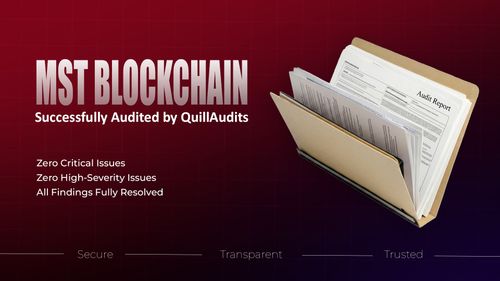
MST Blockchain Security Audit Report: Zero Critical Issues Found by QuillAudits
News & Analysis Security Audit June 2026 · 5 min read MST Chain passes independent Web3 security review with zero critical and zero high-severity findings — all issues fully resolved. MST Blockchain has successfully completed a comprehensive smart contract security audit conducted by QuillAudits, one of the most established names in Web3 security auditing. With over seven years of industry experience, QuillAudits has secured more than 1,400 blockchain projects globally and helped prevent over $3 billion in potential losses across the ecosystem. The results speak for themselves: zero critical issues and zero high-severity issues were identified. 0 Critical Issues 0 High Severity 3 Medium Resolved ✓ 1 Low Resolved ✓ 100% Resolved: Every single issue identified during the audit has been addressed and resolved by the MST Blockchain development team. This security audit report marks a major milestone in MST Chain's journey toward becoming a secure, transparent, and reliable Layer 1 blockchain. No "Trust Us" — Why Audits Matter in Web3 In the world of blockchain, trust cannot be assumed — it has to be earned and verified. Any project can claim its blockchain network is secure, but claims alone don't protect user funds or guarantee network stability. That's why independent smart contract audits exist: to have a neutral third party rigorously examine the code, stress-test its logic, and confirm — or challenge — a project's security posture. For a Layer 1 blockchain like MST Chain, this is especially critical. Unlike a single smart contract or dApp, an L1 protocol underpins the entire ecosystem built on top of it — every transaction, every validator, every dApp, and every user interaction relies on the underlying chain functioning exactly as intended. This is why blockchain security audits at the protocol level carry so much weight. Our commitment: By subjecting our codebase to an external audit and publishing the full audit report publicly, MST Blockchain reinforces a core principle — security should never be something users are asked to take on faith. It should be something they can verify for themselves. Meet MST Chain: What Got Put Under the Microscope The MST Chain audit covered the following scope: Field Detail Project Name MST Blockchain Protocol Type Layer 1 (L1) Blockchain Architecture EVM-compatible, forked from BNB Smart Chain — low fees, high throughput Native Token MSTC — used for gas fees and ecosystem activity Language Audited Go Branch Reviewed Main Project URL mstblockchain.com Source Code Publicly available on GitHub Inside the Vault: How the Audit Was Conducted QuillAudits applied a multi-layered audit methodology to ensure comprehensive coverage of the MST Chain codebase, combining automated tooling with hands-on manual security expertise: 🔍 Structural Analysis Reviewing design patterns and architecture to ensure the code is built in a way that won't create future vulnerabilities. ⚙️ Static Analysis Running automated vulnerability scanning tools across the code to flag irregular patterns without executing the code. 👁️ Manual Code Review A full line-by-line security review, cross-referencing logic against MST Chain's intended design to catch issues automated tools might miss. ⛽ Gas Consumption Review Evaluating performance in production-like conditions and identifying gas optimization opportunities. The audit combined industry-standard smart contract security tools — including Remix IDE, Foundry, Solhint, Mythril, and Slither — alongside extensive manual expertise. The Scorecard: 0 Critical, 0 High, 100% Resolved Out of the full security review, a total of four issues were identified: Severity Level Count Status 🟢 Critical 0 None Found 🟢 High Severity 0 None Found 🟡 Medium Severity 3 ✓ Resolved 🔵 Low Severity 1 ✓ Resolved No critical or high-severity smart contract vulnerabilities — the categories that typically carry the greatest risk to user funds or network stability — were found anywhere in the MST Blockchain codebase. The issues identified centered on configuration handling within the node codebase — specifically, how certain time- and block-related parameters were calculated and validated. None involved exploitable vulnerabilities related to fund security, unauthorized access, or consensus manipulation. Behind the Scenes: What We Fixed While full technical details are available in the public audit report, here is a high-level summary of the security improvements made: 1 Configuration Consistency Hardcoded calculations were updated to dynamically derive values from a single, consistent source — reducing the risk of mismatched values across the codebase. 2 Startup Validation New validation checks catch configuration errors early — at node startup — rather than allowing the system to silently run on incorrect values. 3 Code Documentation & Organization Clarified relationships between interdependent parameters, improving long-term maintainability during future upgrades and hard forks. These fixes strengthen the long-term reliability of MST Blockchain's infrastructure as the network scales. Straight from the Auditor's Mouth "No critical issues in MST Blockchain, just 3 issues of medium severity and 1 low severity were found, which were resolved by the team." — QuillAudits, Official Audit Report QuillAudits also notes in its disclaimer that a security audit represents an assessment at a specific point in time. It is not a guarantee of absolute security, nor investment advice — blockchain security is an ongoing discipline, not a one-time achievement. This Is Just the Beginning This audit is one milestone in an ongoing security commitment — not a finish line. In line with QuillAudits' recommendations, MST Blockchain plans to continue investing in: Regular, independent security audits as the chain evolves Continuous on-chain monitoring for early threat detection A future public bug bounty program to incentivize responsible vulnerability disclosure Read the Full MST Blockchain Audit Report Transparency builds trust — and trust is earned through verification, not promises. The full MST Blockchain audit report is publicly available for anyone in the community to review. Verify MST Blockchain's Security — For Yourself The full audit report is public. Read every finding, every fix, and every resolution — no paywalls, no gatekeeping. Read the Full Audit Report Verify on QuillAudits Leaderboard Frequently Asked Questions Is MST Blockchain safe to use? Yes. MST Blockchain completed an independent security audit by QuillAudits in June 2026, and the review found zero critical and zero high-severity vulnerabilities. Four minor issues (three medium, one low severity) were identified and have all been fully resolved. Who conducted the MST Blockchain security audit? QuillAudits conducted the MST Blockchain security audit. QuillAudits is a Web3 security firm with over seven years of experience, having audited more than 1,400 blockchain projects and helped prevent over $3 billion in losses. How many vulnerabilities were found in the MST Blockchain audit? The MST Blockchain audit found four total issues: zero critical, zero high-severity, three medium-severity, and one low-severity issue. All four issues have been resolved by the MST Blockchain team. What is MST Blockchain? MST Blockchain is a Layer 1, EVM-compatible blockchain network built as a fork of the BNB Smart Chain, offering low transaction fees and high throughput. Its native token, MSTC, is used for gas fees and ecosystem activity. What tools did QuillAudits use to audit MST Blockchain? QuillAudits used a combination of industry-standard tools including Remix IDE, Foundry, Solhint, Mythril, and Slither, alongside extensive manual code review by experienced Web3 security engineers. What type of issues were found in the audit? The issues identified were related to configuration handling within the node codebase — specifically how time- and block-related parameters were calculated and validated. None involved exploitable vulnerabilities related to fund security, unauthorized access, or consensus manipulation. Will MST Blockchain conduct future security audits? Yes. MST Blockchain is committed to regular, independent security audits as the chain evolves, continuous on-chain monitoring, and plans to launch a public bug bounty program to incentivize responsible vulnerability disclosure. Where can I read the full MST Blockchain audit report? The full audit report is publicly available at mstblockchain.com/audit-report.pdf and can also be verified on the QuillAudits leaderboard at quillaudits.com/leaderboard. M MST Blockchain Editorial Team mstblockchain.com — Blockchain education, SARAL Protocol, Web3 insights MST Blockchain Security Audit QuillAudits Smart Contract Security Layer 1 Blockchain Security Web3 Security Audit 2026 MST Chain EVM Compatible Blockchain Zero Critical Vulnerabilities
MST Blockchain Q2 2026 Report: 75,000+ Validators, FortunX Protocol & Global Web3 Expansion
MST Blockchain's Layer-1 network entered a new phase of maturity in Q2 2026. From April through June, MST Blockchain moved from network expansion into protocol innovation — crossing 75,000 validators, launching the FortunX prediction market protocol, completing the Dencun testnet upgrade, integrating with SafePal wallet, and signing four strategic partnerships spanning infrastructure, gaming, and enterprise adoption. "Q1 proved the network could scale. Q2 proved it could build — a live DeFi protocol, a stronger testnet, and a wallet integration that puts MST in front of a global user base." This quarterly report covers everything that happened on the MST Blockchain network between April and June 2026 — network growth, the FortunX Protocol launch, testnet upgrades, wallet integrations, global events, academic partnerships, and what's coming next in Q3. Q2 2026 Network Growth at a Glance The MST Blockchain ecosystem continued its strong growth throughout Q2 2026, reflecting increasing adoption from developers, validators, enterprises, and the Web3 community. The validator network held its Q1 momentum, crossing 75,000 total validators as staking incentives and simplified onboarding continued to draw in new participants. 75,000+ Total Validators 174,253+ Wallets Created 4.599M+ On-Chain Transactions 4 Strategic Partnerships Signed These figures demonstrate the rapid, sustained expansion of the MST Blockchain network while strengthening decentralization, security, and ecosystem participation ahead of a protocol-heavy Q2. Dencun Upgrade Strengthens the MST Blockchain Testnet One of the most significant technical milestones during Q2 was the successful implementation of the Dencun Upgrade on the MST Blockchain Testnet. The upgrade introduced improvements in scalability, transaction efficiency, network performance, and compatibility with modern blockchain standards. Alongside the upgrade, the engineering team implemented several infrastructure enhancements and testnet optimizations to improve stability and provide a better development experience. These improvements further strengthen MST Blockchain as a high-performance Layer-1 blockchain built for enterprise applications and scalable decentralized ecosystems. FortunX Protocol Officially Launches on MST Blockchain Q2 also marked the launch of the FortunX Protocol, a decentralized prediction market protocol powered by MST Blockchain. FortunX enables users to create, participate in, and settle prediction markets through transparent and trustless smart contracts. Built on the MST Layer-1 network, the protocol benefits from fast transaction speeds, low network fees, enhanced security, and scalable infrastructure. The launch represents another important milestone in expanding the MST Blockchain ecosystem with practical decentralized finance (DeFi) applications. Explore the FortunX Protocol → BridgeKey and MST Blockchain Platform Enhancements Improving user experience remained a major focus throughout the quarter. The BridgeKey website was completely revamped with modern branding, improved navigation, enhanced accessibility, and a better onboarding experience for users exploring decentralized identity and Web3 wallet solutions. Website redesign highlights: Improved UI/UX across every page Better developer documentation for faster onboarding Faster navigation and page load times Enhanced ecosystem resources for builders and validators Optimized user experience across mobile and desktop Stronger brand identity aligned with MST's global expansion These improvements create a more accessible experience for developers, validators, enterprises, and ecosystem partners navigating the MST Blockchain platform. Strategic Partnerships Accelerating Ecosystem Growth Collaboration remains one of the strongest drivers behind MST Blockchain's expansion. During Q2 2026, MST Blockchain established strategic partnerships with organizations that strengthen blockchain innovation, enterprise adoption, gaming, and decentralized infrastructure. 🤝 Fystack — Blockchain Infrastructure 🤝 Spores Network — Cross-Chain Innovation 🤝 Shivacha Technologies — Enterprise Solutions 🤝 ArcadeX — Web3 Gaming Fystack accelerates blockchain infrastructure development and ecosystem collaboration, while Spores Network expands decentralized opportunities through cross-chain innovation and digital assets. Shivacha Technologies brings enterprise blockchain solutions for digital transformation initiatives, and ArcadeX strengthens Web3 gaming through digital ownership and blockchain-powered experiences. Together, these partnerships expand the MST ecosystem while creating new opportunities for developers, enterprises, and blockchain communities. SafePal Wallet Integration Accessibility and interoperability are essential for blockchain adoption. During Q2, MST Blockchain successfully integrated with SafePal, allowing users to securely manage MST assets using one of the world's leading multi-chain crypto wallets. Integration highlights: Secure asset storage for MST holdings Multi-chain compatibility across major networks Simplified onboarding for new SafePal users Improved accessibility for global users Better user experience managing MST assets Enhanced interoperability with the broader Web3 ecosystem The SafePal integration makes the MST ecosystem more accessible to users worldwide, pairing MST's low-fee Layer-1 infrastructure with a wallet already trusted by millions of crypto users. Expanding Global Presence Through International Events MST Blockchain strengthened its international visibility through participation in major blockchain and technology conferences. Smart Tech Vietnam 2026 MST Blockchain proudly participated as an Official Partner at Smart Tech Vietnam 2026, connecting with enterprises, startups, developers, investors, and technology leaders while showcasing the capabilities of its Layer-1 blockchain. Unchained Summit Vietnam 2026 MST Blockchain also participated as an Official Partner at Unchained Summit Vietnam 2026, one of Southeast Asia's leading blockchain conferences. The summit enabled meaningful discussions with blockchain innovators, ecosystem partners, venture capital firms, enterprises, and developers, opening new opportunities for international collaboration and ecosystem expansion. Building the Future Through Academic Partnerships Developing blockchain talent remains a long-term priority for MST Blockchain. During Q2, academic Memorandums of Understanding (MoUs) were signed with leading educational institutions to encourage blockchain research, innovation, internships, and industry collaboration. Nutan Maharashtra Institute of Engineering & Technology (NMIET) — Pune MIT Art, Design and Technology University (MIT ADT) — Pune D. Y. Patil College of Engineering — Akurdi, Pune B. M. S. College of Engineering (BMSCE) — Bengaluru These collaborations help prepare students for careers in blockchain, Web3, and emerging technologies. CampusVerse Continues Nationwide Expansion CampusVerse continued expanding its footprint across India by bringing blockchain education directly to students. During Q2, blockchain workshops and technical sessions were conducted at six universities nationwide. Q2 Campus Sessions: B. M. S. College of Engineering — Bengaluru Vidyashilp University — Bengaluru REVA University — Bengaluru Jain University Global Campus — Kanakapura D. Y. Patil College of Engineering — Pune Vidyavardhaka College of Engineering — Mysuru Students gained hands-on exposure to blockchain fundamentals, smart contracts, decentralized applications, Web3 development, and career opportunities in the blockchain industry. Community Development and Blockchain Education Education continues to be a cornerstone of the MST Blockchain ecosystem. Throughout Q2, the community team organized awareness sessions, technical workshops, Web3 career guidance programs, ecosystem introductions, and developer engagement initiatives designed to educate and empower the next generation of blockchain innovators. By investing in education, community building, and developer adoption, MST Blockchain is creating a sustainable ecosystem that supports long-term innovation. Looking Ahead to Q3 2026 As MST Blockchain enters the third quarter of 2026, the focus remains on expanding the Layer-1 ecosystem through continuous innovation, stronger enterprise adoption, strategic partnerships, developer-focused tools, and global community growth. Here is what the community can expect: Additional ecosystem integrations across wallets and dApps Infrastructure enhancements building on the Dencun upgrade New strategic partnerships across DeFi, gaming, and enterprise Expanded CampusVerse educational initiatives in new states Accessibility-focused technologies for real-world blockchain adoption The roadmap includes technologies that make blockchain more accessible, scalable, and practical for real-world applications — building directly on the FortunX and SafePal foundations laid in Q2. Conclusion: MST Blockchain's Ecosystem Keeps Compounding MST Blockchain's Q2 2026 performance shows an ecosystem maturing across every dimension at once: network infrastructure (Dencun upgrade, 75,000+ validators), product innovation (FortunX Protocol), accessibility (SafePal integration), global visibility (Smart Tech Vietnam, Unchained Summit Vietnam), and community education (CampusVerse, academic MoUs). These milestones reinforce MST Blockchain's mission of building a secure, scalable, developer-friendly, and enterprise-ready blockchain ecosystem that supports the next generation of decentralized applications. The infrastructure is ready. The ecosystem is scaling. MST Blockchain is just getting started. Stay connected with MST Blockchain Follow the journey and join India's fastest-growing Web3 community: Website | Telegram | X (Twitter) | LinkedIn Frequently Asked Questions — MST Blockchain Q2 2026 Q1. What is MST Blockchain? MST Blockchain is a high-performance Layer-1 blockchain platform designed to deliver scalable, secure, and enterprise-ready infrastructure for decentralized applications, digital assets, and Web3 solutions. Q2. What are the key achievements of MST Blockchain in Q2 2026? Major achievements include the Dencun Upgrade on the MST Testnet, crossing 75,000+ validators, launching the FortunX Protocol, integrating with SafePal, revamping the MST Blockchain and BridgeKey websites, expanding CampusVerse, signing academic MoUs, and participating as an Official Partner at Smart Tech Vietnam and Unchained Summit Vietnam. Q3. What is the FortunX Protocol? FortunX Protocol is a decentralized prediction market built on MST Blockchain that enables transparent and trustless event-based markets using smart contracts. Q4. Why is the Dencun Upgrade important? The Dencun Upgrade improves network scalability, transaction efficiency, and developer experience while enhancing compatibility with modern blockchain technologies. Q5. What is BridgeKey? BridgeKey is MST Blockchain's Web3 identity and wallet ecosystem that simplifies decentralized identity management and secure blockchain interactions. Q6. Why did MST Blockchain integrate with SafePal? SafePal integration allows users to securely store and manage MST assets through a trusted multi-chain wallet, improving accessibility and interoperability. Q7. What is CampusVerse? CampusVerse is MST Blockchain's educational initiative that introduces students and universities to blockchain technology, Web3 development, decentralized applications, and blockchain career opportunities. In Q2 2026, CampusVerse ran sessions at six universities across Bengaluru, Kanakapura, Pune, and Mysuru. Q8. Which universities partnered with MST Blockchain during Q2 2026? MST Blockchain signed academic collaborations with NMIET Pune, MIT ADT University Pune, D. Y. Patil College of Engineering Pune, and BMS College of Engineering Bengaluru. Q9. What strategic partnerships were announced during Q2? MST Blockchain announced strategic partnerships with Fystack, Spores Network, Shivacha Technologies, and ArcadeX to strengthen blockchain innovation, enterprise adoption, Web3 gaming, and ecosystem growth. Q10. What can the community expect in Q3 2026? Q3 will focus on infrastructure enhancements, ecosystem expansion, enterprise partnerships, developer tools, global collaborations, educational programs, and broader Web3 adoption. { "@context": "https://schema.org", "@type": "FAQPage", "mainEntity": [ {"@type":"Question","name":"What is MST Blockchain?","acceptedAnswer":{"@type":"Answer","text":"MST Blockchain is a high-performance Layer-1 blockchain platform designed to deliver scalable, secure, and enterprise-ready infrastructure for decentralized applications, digital assets, and Web3 solutions."}}, {"@type":"Question","name":"What are the key achievements of MST Blockchain in Q2 2026?","acceptedAnswer":{"@type":"Answer","text":"Major achievements include the Dencun Upgrade on the MST Testnet, crossing 75,000+ validators, launching the FortunX Protocol, integrating with SafePal, revamping the MST Blockchain and BridgeKey websites, expanding CampusVerse, signing academic MoUs, and participating as an Official Partner at Smart Tech Vietnam and Unchained Summit Vietnam."}}, {"@type":"Question","name":"What is the FortunX Protocol?","acceptedAnswer":{"@type":"Answer","text":"FortunX Protocol is a decentralized prediction market built on MST Blockchain that enables transparent and trustless event-based markets using smart contracts."}}, {"@type":"Question","name":"Why is the Dencun Upgrade important?","acceptedAnswer":{"@type":"Answer","text":"The Dencun Upgrade improves network scalability, transaction efficiency, and developer experience while enhancing compatibility with modern blockchain technologies."}}, {"@type":"Question","name":"What is BridgeKey?","acceptedAnswer":{"@type":"Answer","text":"BridgeKey is MST Blockchain's Web3 identity and wallet ecosystem that simplifies decentralized identity management and secure blockchain interactions."}}, {"@type":"Question","name":"Why did MST Blockchain integrate with SafePal?","acceptedAnswer":{"@type":"Answer","text":"SafePal integration allows users to securely store and manage MST assets through a trusted multi-chain wallet, improving accessibility and interoperability."}}, {"@type":"Question","name":"What is CampusVerse?","acceptedAnswer":{"@type":"Answer","text":"CampusVerse is MST Blockchain's educational initiative that introduces students and universities to blockchain technology, Web3 development, decentralized applications, and blockchain career opportunities."}}, {"@type":"Question","name":"Which universities partnered with MST Blockchain during Q2 2026?","acceptedAnswer":{"@type":"Answer","text":"MST Blockchain signed academic collaborations with NMIET Pune, MIT ADT University Pune, D. Y. Patil College of Engineering Pune, and BMS College of Engineering Bengaluru."}}, {"@type":"Question","name":"What strategic partnerships were announced during Q2?","acceptedAnswer":{"@type":"Answer","text":"MST Blockchain announced strategic partnerships with Fystack, Spores Network, Shivacha Technologies, and ArcadeX to strengthen blockchain innovation, enterprise adoption, Web3 gaming, and ecosystem growth."}}, {"@type":"Question","name":"What can the community expect in Q3 2026?","acceptedAnswer":{"@type":"Answer","text":"Q3 will focus on infrastructure enhancements, ecosystem expansion, enterprise partnerships, developer tools, global collaborations, educational programs, and broader Web3 adoption."}} ] } ==================================================================== -->
Solidity Compiler Compatibility on MST Blockchain
Developer Reference Smart Contracts What Every Developer Needs to Know If you've been deploying smart contracts on MST blockchain and run into cryptic compilation errors or unexpected reverts, there's a good chance your toolchain is silently compiling against a Solidity version your target network doesn't support. This guide explains why that happens and exactly how to fix it. The Two Networks, and Where They Stand MST blockchain runs two environments: Mainnet and Testnet. They don't share the same EVM capabilities, and that asymmetry is the root cause of most compiler-related headaches. Mainnet Testnet EVM Version Paris Cancun Upcoming Upgrade → Cancun (soon) Already upgraded Supports latest Solidity? No Partial Mainnet — Paris EVM Mainnet currently runs on the Paris EVM hardfork. This means any opcode or feature introduced after Paris — such as PUSH0 (Shanghai) or TLOAD/TSTORE (Cancun) — is not available. Contracts compiled targeting these newer EVMs will fail to deploy or behave unexpectedly on mainnet. Mainnet will be upgraded to Cancun in the near future, but until that happens, you must compile targeting Paris. Testnet — Cancun EVM Testnet has already been upgraded to support the Cancun EVM hardfork. This unlocks transient storage (TLOAD/TSTORE), blob-carrying transactions (EIP-4844 primitives), and other Cancun-era features. However, testnet does not support the most recent Solidity versions released after Cancun. Bleeding-edge compiler versions may introduce new opcodes or language features the testnet EVM doesn't yet recognise. Why Your Framework Is Using the Wrong Compiler Both Foundry and Hardhat default to the latest available Solidity compiler. This is great for greenfield projects targeting cutting-edge networks, but it becomes a problem when: You're deploying to mainnet (Paris), and the latest solc targets Shanghai or Cancun opcodes. You're deploying to testnet (Cancun), and the latest solc uses post-Cancun features not yet recognised by the EVM. The result is usually one of these failure modes: InvalidOpcode revert at runtime (compiled opcode not recognised by the EVM) EvmVersionMismatch errors during deployment Subtle bugs from opcodes silently falling back to unintended behaviour The fix is straightforward: pin the EVM target and the Solidity version in your project configuration. Recommended Compiler Versions Target Network EVM Version Recommended Solidity Mainnet (current) paris ^0.8.20 Mainnet (post-upgrade) cancun ^0.8.24 Testnet cancun ^0.8.24 Avoid on either network — >= 0.8.25 (until confirmed) Note: Avoid using ^0.8.25 or later on testnet until those versions are explicitly confirmed as supported. When in doubt, use 0.8.24. Fixing It in Foundry Foundry is configured via foundry.toml at the root of your project. For Mainnet (Paris EVM) # foundry.toml [profile.default] solc = "0.8.20" evm_version = "paris" For Testnet (Cancun EVM) # foundry.toml [profile.default] solc = "0.8.24" evm_version = "cancun" Using Profiles to Handle Both Networks Foundry's profile system lets you define separate configs and switch between them with an environment variable. # foundry.toml [profile.default] solc = "0.8.20" evm_version = "paris" [profile.testnet] solc = "0.8.24" evm_version = "cancun" Then activate the testnet profile when needed: # Deploy or test against testnet FOUNDRY_PROFILE=testnet forge build FOUNDRY_PROFILE=testnet forge test FOUNDRY_PROFILE=testnet forge script script/Deploy.s.sol \ --rpc-url $TESTNET_RPC_URL --broadcast Omitting FOUNDRY_PROFILE always falls back to [profile.default] — which you should keep pointing at mainnet (Paris) for safety. Verifying Your Build Target forge build --force 2>&1 | grep 'Compiler' # Expected: Compiling X files with 0.8.20 (or 0.8.24) Fixing It in Hardhat Hardhat is configured in hardhat.config.js (or hardhat.config.ts for TypeScript). For Mainnet (Paris EVM) // hardhat.config.js require("@nomicfoundation/hardhat-toolbox"); /** @type import("hardhat/config").HardhatUserConfig */ module.exports = { solidity: { version: "0.8.20", settings: { evmVersion: "paris", optimizer: { enabled: true, runs: 200, }, }, }, }; For Testnet (Cancun EVM) // hardhat.config.js require("@nomicfoundation/hardhat-toolbox"); module.exports = { solidity: { version: "0.8.24", settings: { evmVersion: "cancun", optimizer: { enabled: true, runs: 200, }, }, }, }; TypeScript Config // hardhat.config.ts import { HardhatUserConfig } from "hardhat/config"; import "@nomicfoundation/hardhat-toolbox"; const config: HardhatUserConfig = { solidity: { version: "0.8.24", settings: { evmVersion: "cancun", // or "paris" for mainnet optimizer: { enabled: true, runs: 200, }, }, }, }; export default config; Supporting Multiple Solidity Versions If your project has contracts that need different versions (e.g. third-party dependencies with a different pragma), use the compilers array: // hardhat.config.js module.exports = { solidity: { compilers: [ { version: "0.8.24", // Your contracts (testnet) settings: { evmVersion: "cancun", optimizer: { enabled: true, runs: 200 }, }, }, { version: "0.8.20", // Legacy dependency contracts settings: { evmVersion: "paris", optimizer: { enabled: true, runs: 200 }, }, }, ], }, }; Environment-Aware Config A clean pattern for keeping mainnet and testnet configs in one file: // hardhat.config.js const isTestnet = process.env.NETWORK === "testnet"; module.exports = { solidity: { version: isTestnet ? "0.8.24" : "0.8.20", settings: { evmVersion: isTestnet ? "cancun" : "paris", optimizer: { enabled: true, runs: 200 }, }, }, networks: { mainnet: { url: process.env.MAINNET_RPC_URL || "", accounts: [process.env.PRIVATE_KEY], }, testnet: { url: process.env.TESTNET_RPC_URL || "", accounts: [process.env.PRIVATE_KEY], }, }, }; Then deploy with: # Testnet NETWORK=testnet npx hardhat run scripts/deploy.js --network testnet # Mainnet npx hardhat run scripts/deploy.js --network mainnet Also Pin the Version in Your Contract Pragma Beyond your build tool config, it's good practice to be explicit in your Solidity source files too. Avoid open-ended pragmas like pragma solidity ^0.8.0; — these allow the compiler to pick any version and can mask version drift. // Good — explicit upper bound pragma solidity ^0.8.20; // mainnet pragma solidity ^0.8.24; // testnet // Avoid — too permissive pragma solidity >=0.8.0; pragma solidity ^0.8.0; Pre-Deploy Checklist Before deploying to either network, run through this: ✓foundry.toml or hardhat.config.js has the correct solc/version set ✓evm_version / evmVersion matches your target network (paris or cancun) ✓Your contract pragma is explicitly pinned, not open-ended ✓You've run a fresh forge build --force or npx hardhat compile --force after any config change ✓You're not using Cancun-only features (TLOAD, TSTORE, blobhash) in contracts destined for mainnet until the upgrade lands After the Mainnet Cancun Upgrade Once mainnet upgrades to Cancun, you can consolidate your configs: Both networks will share the same EVM target (cancun) You can safely move to solc 0.8.24 across the board for all deployments Watch the official MST announcements for the exact upgrade date — until then, keep mainnet builds targeting paris Summary Scenario EVM Version Solidity Version Deploying to Mainnet today paris 0.8.20 Deploying to Testnet today cancun 0.8.24 After Mainnet Cancun upgrade cancun 0.8.24 Avoid on either network — >= 0.8.25 (until confirmed) Pinning your compiler version takes two lines of config, but it saves you from silent failures, unexpected reverts, and hours of debugging gas estimation errors. Set it once per environment, commit it to your repo, and move on. Stay connected with MST Blockchain Follow the journey and join India's fastest-growing Web3 community: Website | Telegram | X (Twitter) | LinkedIn
Top 10 Blockchain Use Cases Changing Industries Right Now
Top 10 Blockchain Use Cases Changing Industries in 2026 | MST Blockchain Listicle Real-World Blockchain Applications 23 June 2026 · 10 min read Blockchain is no longer a technology in search of a problem. In 2026, it is live infrastructure quietly reshaping how goods move across borders, how medical records are shared, how trillions of dollars are settled — and how trust is established without a middleman. These are the ten blockchain use cases that are changing industries right now. When Bitcoin launched in 2009, blockchain was synonymous with cryptocurrency. Today, the technology has broken free of that single application. Enterprises, governments, hospitals, and financial institutions are all deploying blockchain infrastructure — not because it is fashionable, but because it solves real problems that decades of centralised software could not. This guide covers the top 10 blockchain use cases in 2026 — ranked by current adoption, measurable impact, and momentum. For each, we explain the problem blockchain solves, the leading real-world deployments, and what the near future looks like. $67.4B Projected global blockchain market size by 2026 87% Of Fortune 500 companies actively piloting or deploying blockchain $16T+ Estimated value of assets that could be tokenised on-chain by 2030 1 Supply Chain Transparency & Traceability blockchain in supply chain Global supply chains involve dozens of intermediaries, paper-based records, and no single source of truth. Counterfeit goods, food safety scandals, and cargo theft cost the global economy hundreds of billions of dollars annually. Blockchain fixes this by creating an immutable, shared ledger that every participant — manufacturer, shipper, customs authority, retailer — can read and write to in real time. Real deployments: Walmart uses the IBM Food Trust blockchain to trace leafy greens from farm to shelf in seconds rather than days. Maersk's TradeLens platform digitised shipping documentation for over 300 ocean carriers. De Beers' Tracr platform tracks every diamond from mine to jeweller, eliminating conflict diamonds from the supply chain. 2026 momentum: Pharmaceutical companies are now mandated in several jurisdictions to use blockchain-verified supply chain data to combat drug counterfeiting — a $200B global problem. 2 Decentralised Finance (DeFi) & Banking blockchain finance Over 1.4 billion people globally remain unbanked or underbanked. DeFi protocols deployed on blockchain networks offer lending, borrowing, earning yield, and transferring value to anyone with a smartphone — no credit score, no branch visit, no approval required. In 2026, DeFi has grown beyond retail users to attract institutional capital seeking programmable, transparent, 24/7 financial infrastructure. Real deployments: Aave and Morpho collectively manage billions in on-chain lending. JPMorgan's Onyx platform settles interbank repo transactions on a permissioned blockchain. BlackRock's BUIDL fund tokenises US Treasury exposure on Ethereum, paying daily yield to on-chain holders. 2026 momentum: Total Value Locked (TVL) in DeFi protocols has recovered and expanded. Institutional DeFi — with KYC-gated pools and regulatory-compliant smart contracts — is the fastest-growing segment. 3 Healthcare Records & Drug Traceability healthcare blockchain Healthcare data is siloed across thousands of incompatible systems. Medical errors caused by missing or incorrect patient records kill an estimated 250,000 Americans annually. Blockchain enables patient-controlled, interoperable health records that travel with the individual across providers, insurers, and borders — without sacrificing privacy, through zero-knowledge proofs and selective disclosure. Real deployments: Estonia's national health system runs on a blockchain-backed infrastructure, giving citizens full control over who accesses their records. MedRec, developed at MIT, allows patients to grant or revoke provider access via smart contracts. The US Drug Supply Chain Security Act (DSCSA) now requires pharmaceutical distributors to maintain blockchain-verified traceability data. 2026 momentum: Post-pandemic urgency has accelerated digital health infrastructure globally. Blockchain-verified vaccine credentials and cross-border health record sharing are now live in over 40 countries. 4 Real-World Asset (RWA) Tokenisation real-world blockchain applications Tokenisation converts ownership rights of real-world assets — property, bonds, commodities, private equity — into digital tokens on a blockchain. This unlocks fractional ownership, 24/7 liquidity, and programmable compliance for asset classes that have historically been illiquid and inaccessible to ordinary investors. Real deployments: BlackRock's BUIDL fund and Franklin Templeton's FOBXX are tokenised money market funds on public blockchains. Ondo Finance offers tokenised US Treasuries with same-day settlement. Singapore's MAS Project Guardian has successfully piloted tokenised bonds and foreign exchange on public blockchains with major banks. 2026 momentum: The tokenised RWA market has crossed $15 billion on-chain. Standard Chartered, HSBC, and Goldman Sachs all have active tokenisation desks. This is the fastest-growing institutional blockchain use case in 2026. 5 Cross-Border Payments & Remittances blockchain finance The global remittance market moves over $800 billion per year — and traditional intermediaries take 5–7% in fees while transactions take 2–5 business days. Blockchain-based payment rails settle transactions in seconds at a fraction of a cent, with full auditability and no correspondent banking dependency. Real deployments: Ripple's XRP Ledger processes cross-border payments for financial institutions in over 55 countries. Stellar powers remittances across Africa and Southeast Asia for platforms like MoneyGram. USDC-based payment corridors now move billions of dollars monthly between the US, Mexico, and the Philippines at near-zero cost. 2026 momentum: The GENIUS Act has provided US regulatory clarity for stablecoin payment rails, unlocking institutional participation in blockchain-based payments at a scale previously impossible. 6 Digital Identity & Self-Sovereign Identity (SSI) real-world blockchain applications Identity fraud costs the global economy over $50 billion annually. More critically, over one billion people lack any officially recognised identity document — cutting them off from banking, healthcare, and legal rights. Blockchain-based self-sovereign identity (SSI) gives individuals a verifiable, portable digital identity they own and control — without dependence on any single government or corporation. Real deployments: The European Union's eIDAS 2.0 regulation mandates a blockchain-compatible digital identity wallet for all EU citizens by 2026. Microsoft's Entra Verified ID uses decentralised identifiers (DIDs) for enterprise credential verification. The World Food Programme's Building Blocks project provides blockchain-based identity and payment to refugees in Jordan. 2026 momentum: On-chain credentials are being piloted for university degrees, professional licences, and KYC verification — enabling one-click compliance across multiple institutions from a single verified identity. 7 Smart Contracts for Insurance & Legal Agreements blockchain finance Insurance claims processing averages 14–30 days. Legal contract execution requires lawyers, notaries, and courts as trusted intermediaries. Smart contracts — self-executing code deployed on blockchain — automate both, triggering payouts and enforcing agreement terms automatically when predefined conditions are met, without human intervention or dispute. Real deployments: Etherisc offers parametric crop insurance on Ethereum — farmers in Kenya receive automatic payouts when satellite rainfall data falls below a threshold, no claims process required. AXA's Fizzy product offered automatic flight delay insurance via smart contract. In the legal sector, platforms like OpenLaw and Clause.io enable legally binding contracts with on-chain execution. 2026 momentum: Parametric insurance — powered by blockchain oracles like Chainlink — is expanding into climate risk, supply chain disruption, and cyber insurance, with instant payouts replacing months-long claims processes. 8 Carbon Credits & ESG Reporting real-world blockchain applications The voluntary carbon market is plagued by fraud, double-counting, and opacity. A 2023 investigation found that over 90% of a major certifier's rainforest credits were worthless. Blockchain solves this by creating a single, auditable registry where each carbon credit is a unique token — issued once, retired once, and traceable from project to buyer with complete transparency. Real deployments: Toucan Protocol and KlimaDAO have brought millions of carbon credits on-chain. The Gold Standard and Verra are exploring blockchain-based registries. South Korea and Singapore have launched blockchain-backed national carbon markets. Shell and BP are piloting tokenised carbon credit trading desks. 2026 momentum: EU Corporate Sustainability Reporting Directive (CSRD) requires verifiable ESG data from large companies. Blockchain-backed ESG reporting is rapidly becoming a compliance necessity rather than a nice-to-have. 9 Government Services & Voting Systems real-world blockchain applications Government services are frequently slow, expensive, and vulnerable to fraud and corruption. Land registries are forged. Voting systems are contested. Public procurement is riddled with kickbacks. Blockchain provides tamper-proof public records and transparent audit trails that make these systems dramatically harder to corrupt. Real deployments: Georgia (the country) has recorded over 1.5 million land titles on a blockchain since 2016 — eliminating title fraud almost entirely. West Virginia piloted blockchain-based absentee voting for military personnel. Dubai's government has a target to process all government documents on blockchain, with many departments already live. Ukraine's government has moved critical public records onto blockchain infrastructure. 2026 momentum: Over 45 countries are now running active blockchain-in-government programmes, according to the UN. Public sector blockchain spend is projected to grow 60% annually through 2028. 10 Education Credentials & Skill Verification real-world blockchain applications Diploma fraud costs employers and institutions billions annually. Verifying a candidate's educational credentials can take weeks and require international correspondence. Blockchain-issued digital credentials are instantly verifiable by any employer, anywhere in the world — with cryptographic proof of authenticity that cannot be forged. Real deployments: MIT has issued blockchain-verified diplomas since 2017 via the Blockcerts open standard. Singapore's SkillsFuture programme issues blockchain-verified skill credentials to workers. The European Blockchain Services Infrastructure (EBSI) is standardising cross-border academic credential verification across EU member states. LinkedIn now accepts blockchain-verified skill badges from partnered institutions. 2026 momentum: The rise of AI-generated CVs and fake credentials has made blockchain verification more urgent than ever. Companies including PwC, Deloitte, and Accenture have announced blockchain-only credential verification for senior hires. Quick Reference: All 10 Use Cases at a Glance # Use Case Industry Maturity Impact 1Supply Chain TraceabilityLogistics, Retail, PharmaLive at scale⭐⭐⭐⭐⭐ 2DeFi & BankingFinanceLive at scale⭐⭐⭐⭐⭐ 3Healthcare RecordsHealthcare, PharmaGrowing fast⭐⭐⭐⭐⭐ 4RWA TokenisationFinance, Real EstateGrowing fast⭐⭐⭐⭐⭐ 5Cross-Border PaymentsFintech, BankingLive at scale⭐⭐⭐⭐⭐ 6Digital Identity (SSI)Government, HR, FinanceGrowing fast⭐⭐⭐⭐ 7Smart Contract InsuranceInsurance, LegalGrowing fast⭐⭐⭐⭐ 8Carbon Credits & ESGEnergy, ComplianceGrowing fast⭐⭐⭐⭐ 9Government & VotingPublic SectorGrowing fast⭐⭐⭐⭐ 10Education CredentialsEducation, HRGrowing fast⭐⭐⭐⭐ The Bottom Line The most important thing these ten use cases have in common is this: they all solve the same fundamental problem. In every case, multiple parties need to share data or transfer value — but they do not fully trust each other, and a central intermediary is either too expensive, too slow, or too corruptible to serve as the trusted third party. Blockchain replaces institutional trust with mathematical trust. That simple shift — from trusting people and organisations to trusting code and cryptography — is why the technology is spreading across industries that have nothing else in common. A shipping container, a blood test result, a government land title, and a carbon credit have one thing in common in 2026: they are all more trustworthy on a blockchain. "Blockchain is not one technology serving one industry. It is a trust infrastructure layer being adopted wherever humans and institutions need to cooperate without a shared authority." The question for businesses and developers in 2026 is no longer whether blockchain is real — the deployments above prove it is. The question is which platform, which protocol, and which architecture is right for your use case. That is where the next generation of purpose-built blockchain infrastructure — like MST Blockchain's SARAL Protocol — comes in. Build real-world blockchain applications with MST MST Blockchain's SARAL Protocol is purpose-built for real-world use cases — from on-chain certificates and tokenised assets to enterprise payment infrastructure. Whether you are a developer, business, or institution, MST gives you the infrastructure to go live — not just pilot. Explore MST Blockchain Get Bridgkey Wallet M MST Blockchain Editorial Team mstblockchain.com — Blockchain education, SARAL Protocol, Web3 insights Jump to a Use Case 01 · Supply Chain 02 · DeFi & Banking 03 · Healthcare 04 · RWA Tokenisation 05 · Cross-Border Payments 06 · Digital Identity 07 · Smart Contracts 08 · Carbon Credits & ESG 09 · Government & Voting 10 · Education Credentials
Proof of Stake vs Proof of Work: Which Consensus Wins in 2026?
Proof of Stake vs Proof of Work: Which Consensus Wins in 2026? | MST Blockchain Educational Consensus Algorithm Guide 09 June 2026 · 8 min read Bitcoin still mines. Ethereum no longer does. Four years after the Merge, the proof of stake vs proof of work debate is not settled — it has deepened. This consensus algorithm guide breaks down how each mechanism works, where each wins, and what the data says in 2026. 1. What Is a Blockchain Consensus Mechanism? A blockchain is a distributed ledger — thousands of computers hold an identical copy of the same transaction history. The key engineering challenge is simple to state and hard to solve: how do all those computers agree on which transactions are valid, without trusting a central authority? The answer is a consensus mechanism — a set of mathematical rules that forces participants to prove they have "skin in the game" before they can add a new block to the chain. Get it wrong and you get double-spending, fraud, or a blockchain that collapses under attack. Get it right and you get something genuinely remarkable: trustless agreement at global scale. Since Satoshi Nakamoto published the Bitcoin white paper in 2008, dozens of consensus algorithms have been proposed. Two dominate the conversation in 2026: Proof of Work (PoW) and Proof of Stake (PoS). Understanding the difference between them is foundational for anyone serious about blockchain. 2. How Proof of Work Works (Bitcoin Mining Explained) Proof of Work is the original blockchain consensus algorithm — the one Bitcoin has used since block zero in January 2009. The name is literal: participants prove they have done computational work before they earn the right to add a block. The mining process, step by step 1Transactions broadcast: Users sign and broadcast transactions to the network. 2Miners collect transactions: Specialised computers (miners) bundle unconfirmed transactions into a candidate block. 3The puzzle: Each miner races to find a number — called a nonce — that, when hashed with the block data, produces an output below a target threshold. 4First to solve wins: The miner who finds a valid nonce first broadcasts the solved block to the network. 5Verification and reward: Other nodes verify the solution instantly. The winning miner receives a block reward — currently 3.125 BTC — plus transaction fees. 6Chain extends: The next block references the previous one, creating the immutable chain. Key insight: In proof of work, security comes from energy expenditure. To rewrite history, an attacker must redo all the computational work of the honest chain — an astronomically expensive undertaking at Bitcoin's current hash rate. The hardware of choice is the ASIC (Application-Specific Integrated Circuit) — a chip built for one purpose: solving SHA-256 hashes. ASICs are orders of magnitude more efficient than general-purpose computers for this task, which means Bitcoin mining has become an industrial-scale operation concentrated in regions with cheap electricity. 3. How Proof of Stake Works (Ethereum Consensus Mechanism) Proof of Stake replaces computational work with economic collateral. Instead of burning electricity, participants lock up — or stake — a quantity of the network's native token as a security deposit. The right to propose and validate blocks is granted in proportion to the stake held, weighted by randomness. Ethereum's shift from PoW to PoS — completed in September 2022 in what the community called The Merge — is the largest real-world test of PoS at scale in blockchain history. As of mid-2026, Ethereum's PoS network has processed billions of transactions without a single successful consensus attack. The Ethereum consensus mechanism in practice 1Validators stake ETH: Anyone who deposits 32 ETH into the Beacon Chain deposit contract becomes a validator. Over one million validator keys are active in 2026. 2Committee selection: Every 12-second slot, the protocol pseudo-randomly selects one validator to propose a block and a committee of 128+ validators to attest. 3Block proposal and attestation: The proposer assembles transactions, signs the block, and broadcasts it. Attestors vote on validity. 4Finalisation: After two epochs (~12.8 minutes), blocks become finalised — mathematically guaranteed to be permanent. 5Rewards and penalties: Validators earn ~3–4% APR for honest participation. Misbehaviour triggers slashing, destroying a portion of staked ETH. Key insight: In proof of stake, security comes from economic risk. An attacker must acquire and stake a massive amount of the network's token — making attack financially ruinous through both the acquisition cost and the slashing of their own capital. 4. PoS vs PoW: Head-to-Head Comparison ⛏ Proof of Work Security backed by real-world energy. Proven at scale for 17+ years. Hardware requirements create a physical barrier to attack. Extremely mature and battle-tested. 🪙 Proof of Stake Security backed by economic collateral. Dramatically lower energy use. Faster finality. Slashing punishes attackers financially. Enables more sophisticated governance. Criteria Proof of Work (Bitcoin) Proof of Stake (Ethereum) Edge Energy consumption ~120 TWh / year (2026 est.) ~0.01 TWh / year PoS wins Transaction finality ~60 minutes (6 confirmations) ~12.8 minutes (economic finality) PoS wins Security maturity 17+ years, never broken ~4 years at scale, never broken PoW wins Attack cost (51%) ~$20B+ hardware + energy ~$34B+ ETH to acquire Roughly equal Throughput (L1) ~7 TPS ~15–30 TPS (higher with blobs) PoS wins Decentralisation 5 pools hold ~65% hash rate Lido holds ~28% of stake Both face issues Environmental optics ESG concern for institutions Widely considered sustainable PoS wins Innovation pace Deliberately conservative Active upgrade roadmap PoS wins 5. Security: Which Model Is Harder to Attack? The dominant attack on any blockchain is the 51% attack — gaining majority control of the consensus process to rewrite recent transaction history, enabling double-spends. Both mechanisms make this expensive in very different ways. PoW: the physical moat Attacking Bitcoin requires controlling more than 50% of the global hash rate. That means acquiring millions of ASICs and running them continuously. The cost is estimated in the tens of billions of dollars, and even a successful attack would crater the value of the asset being exploited. Smaller PoW chains have been successfully attacked — Ethereum Classic suffered three 51% attacks in 2020 alone. PoW security scales with hash rate, which scales with miner revenue, which scales with token price. PoS: the economic moat Attacking Ethereum under PoS requires staking enough ETH to control one-third of the validator set. With over 34 million ETH staked as of 2026, that threshold is a multi-billion-dollar commitment — and any misbehaviour triggers slashing, destroying a portion of the attacker's stake automatically. Fair warning: Neither mechanism is invincible. Both depend on the assumption that a majority of participants are economically rational actors who will not destroy the value of their own holdings. 6. Energy: Bitcoin Mining vs Staking by the Numbers This is where the PoS vs PoW comparison becomes most visceral for regulators, institutional ESG teams, and the general public. ~120 TWh Bitcoin annual energy use (2026 est.) — comparable to a mid-sized country ~0.01 TWh Ethereum annual energy use post-Merge — a reduction of ~99.95% ~99.95% Energy reduction achieved by Ethereum's switch from PoW to PoS in 2022 Bitcoin proponents offer several counterpoints that deserve honest engagement. A growing share of Bitcoin mining uses stranded or curtailed renewable energy — power that would otherwise be wasted. PoW can be seen as converting energy into a globally portable, censorship-resistant store of value. But for institutional investors with ESG mandates, the headline number remains a liability for PoW that PoS simply does not share. "Ethereum's move to PoS did not weaken security. It reduced energy consumption by 99.95% while the network continued processing billions of dollars of daily transactions without interruption." 7. Decentralisation: Is PoS Actually More Centralised? This is the sharpest critique of proof of stake. The argument: in PoW, anyone with a computer and electricity can mine (in theory). In PoS, you need capital — 32 ETH is not accessible to the median person globally. In practice, both systems have centralisation problems — they just manifest differently. PoW centralisation Bitcoin mining is heavily concentrated in mining pools. As of 2026, five pools control approximately 65% of Bitcoin's total hash rate. Pool operators exert significant influence over transaction ordering and software upgrade adoption. PoS centralisation Ethereum's staking landscape is dominated by liquid staking protocols, particularly Lido (~28% of staked ETH). Centralised exchanges control another 15–20% collectively. However, PoS has a structural advantage: liquid staking protocols allow users with any amount of ETH to earn staking rewards while delegating validation. Bottom line: Neither PoW nor PoS achieves perfect decentralisation at scale. Both tend toward oligopoly among large operators. PoS offers more pathways for ordinary users to participate economically — even without being direct validators. 8. The 2026 Verdict: Which Consensus Wins? Let us be direct: there is no single answer that applies to every blockchain use case. The right consensus mechanism depends on what you are optimising for. Proof of Work wins if your priority is: Maximum security for a censorship-resistant store of value. Absolute resistance to governance capture. A track record measured in decades. Bitcoin has operated for 17+ years without a successful consensus-layer attack. Proof of Stake wins if your priority is: Energy efficiency and ESG compliance. Faster finality. Higher throughput. A platform for DeFi, stablecoins, NFTs, and real-world assets. Ethereum's Layer 2 ecosystem built on PoS is by far the most active application development environment in blockchain in 2026. The market has largely spoken. PoS now secures the majority of new blockchain deployments. Every new Layer 1 launched since 2022 — Solana, Avalanche, Aptos, Sui — uses a variant of proof of stake or a hybrid mechanism. 2026 summary: Proof of Work remains the gold standard for Bitcoin-style monetary security. Proof of Stake has won the battle for application platform blockchains. The question for the next generation of builders is what comes after both. 9. Beyond PoS and PoW: What MST Blockchain Does Differently Understanding proof of stake and proof of work helps you appreciate why the next generation of blockchain architecture is designed to go further. The limitations of both models — centralisation pressure, throughput ceilings, and the friction of on-chain participation — are precisely the problems that modern protocol design is solving. MST Blockchain is built around the SARAL Protocol — an architecture designed to make blockchain adoption dramatically simpler for developers and non-technical users alike, without sacrificing security. Where conventional PoS networks still require significant technical knowledge and capital to participate meaningfully, SARAL abstracts that complexity — letting builders focus on applications rather than consensus mechanics. MST is also actively working on real-world asset (RWA) use cases — bringing tokenised assets, blockchain-issued certificates, and enterprise payment infrastructure to market. These are exactly the applications that demand the energy efficiency of PoS, the finality of modern consensus, and the developer ergonomics that neither Bitcoin nor Ethereum offers out of the box. Ready to build on what comes next? MST Blockchain's SARAL Protocol makes blockchain development easier than any PoW or PoS chain you have worked on. The DEX is live, Bridgkey Wallet has 25,000+ users, and the MST TGE is on the horizon. Explore MST Blockchain Get Bridgkey Wallet M MST Blockchain Editorial Team mstblockchain.com — Blockchain education, SARAL Protocol, Web3 insights Proof of Stake Proof of Work Consensus Algorithm Guide Ethereum Consensus Mechanism Bitcoin Mining vs Staking PoS vs PoW Comparison Blockchain Fundamentals MST Blockchain
MST Blockchain Partners with Fystack for Enterprise Custody & Wallet Infrastructure
MST Blockchain Partners with Fystack Strengthening Enterprise Digital Asset Infrastructure MST Blockchain is pleased to announce a strategic partnership with Fystack, a leading provider of wallet infrastructure, MPC-powered custody, and treasury management solutions — marking a significant step toward strengthening the infrastructure available to enterprises and fintechs building on the MST ecosystem. As blockchain moves beyond experimentation into real-world business operations, organisations need not just high-performance networks, but secure, reliable digital asset management. This partnership brings both together. Building the Foundation for Real-World Adoption MST Blockchain is an infrastructure-driven Layer-1 ecosystem built for enterprise-grade applications. With EVM compatibility, throughput exceeding 4,000 TPS, and average transaction fees of just 0.000041 MSTC, MST offers a robust, cost-efficient foundation for businesses exploring blockchain — across finance, supply chain, tokenization, digital identity, and asset management. What Fystack Brings to the Ecosystem MPC-Powered Custody Eliminates single points of failure by distributing key management across multiple parties — reducing risk while maintaining full asset control. Secure Wallet Infrastructure Enterprise-grade APIs and workflows for creating and managing wallets at scale. Treasury Management & Governance Spending limits, approval workflows, and governance frameworks for secure, compliant operations. Enterprise-Ready Operations Institutional-grade security with full flexibility, ownership, and operational efficiency. Unlocking New Opportunities Together, MST Blockchain and Fystack enable organisations to: Build and deploy scalable blockchain applications Securely manage digital assets and treasury operations Implement governance and approval mechanisms Reduce operational risks tied to custody management Accelerate Web3 adoption across enterprise environments A Shared Vision By combining MST's high-performance Layer-1 infrastructure with Fystack's institutional-grade asset management, this collaboration creates a stronger foundation for businesses entering the digital asset economy — without compromising security, scalability, or control. Looking Ahead As the partnership evolves, MST Blockchain and Fystack will continue exploring ways to enhance the ecosystem — providing enterprises the infrastructure they need to build, operate, and scale confidently. About MST Blockchain An infrastructure-driven Layer-1 ecosystem designed to power scalable, secure, real-world blockchain applications. EVM-compatible, high throughput, ultra-low fees — built for the next generation of Web3 solutions. About Fystack Self-hosted custody infrastructure for enterprises, fintechs, and Web3 businesses — covering wallet management, MPC key custody, transaction policy enforcement, and treasury operations. Stay connected with MST Blockchain Follow the journey and join India's fastest-growing Web3 community: Website | Telegram | X (Twitter) | LinkedIn
MST Blockchain at Unchained Summit Vietnam 2026: Driving the Future of Enterprise Blockchain
MST Blockchain at Unchained Summit Vietnam 2026: Driving the Future of Enterprise Blockchain Meta Description: MST Blockchain showcased its enterprise blockchain infrastructure, Layer 1 innovation, and Web3 scalability solutions at Unchained Summit Vietnam 2026, strengthening its presence across Southeast Asia. MST Blockchain is a next-generation Layer 1 blockchain platform designed for enterprise and consumer applications. With over 73,500 validators, 4,000+ TPS processing capability, ultra-low transaction costs, and a growing Web3 ecosystem, MST Blockchain is helping organizations adopt scalable blockchain infrastructure across industries. MST Blockchain Expands Its Global Presence At Unchained Summit Vietnam 2026, MST Blockchain demonstrated its commitment to accelerating enterprise blockchain adoption across Southeast Asia. As a Gold Sponsor, the company engaged directly with investors, regulators, developers, and business leaders seeking practical blockchain solutions. Why Unchained Summit Vietnam 2026 Matters Vietnam has become one of the most active blockchain and digital asset markets globally. The summit provided a valuable platform for showcasing blockchain infrastructure capable of supporting real-world business applications beyond cryptocurrency trading. Building Scalable Enterprise Blockchain Infrastructure MST Blockchain focuses on solving the challenges that often prevent enterprises from adopting blockchain technology at scale. Instead of emphasizing transaction speed alone, the platform delivers a balanced combination of performance, usability, security, and cost efficiency. Key Technologies Powering MST Blockchain 4,000+ TPS using Proof of Stake Authority (PoSA) 73,500+ Active Validators securing the network Ultra-Low Fees averaging 0.001 MSTC SARAL Protocol for simplified onboarding WASMify for enterprise integration Post-Quantum Security architecture BridgeKey Wallet supporting a growing Web3 ecosystem Industry Engagement and Strategic Partnerships The MST Blockchain booth attracted strong interest from leading Web3 organizations including Circle, Alchemy, Dash, No Limit Holdings, TOTM Labs, Onigiri Capital, and DIGITAL TRVST. These interactions highlighted growing recognition of MST Blockchain's potential across digital identity, payments, DeFi, and enterprise blockchain solutions. Why Southeast Asia Is Emerging as a Blockchain Hub Southeast Asia continues to attract blockchain innovation due to rising digital adoption, supportive government initiatives, expanding fintech ecosystems, and increasing demand for secure digital infrastructure. Why Enterprise Blockchain Adoption Is Accelerating in Southeast Asia Governments and enterprises across the region are investing in digital transformation initiatives that require transparency, security, and interoperability. Enterprise blockchain applications are increasingly being explored for supply chain management, healthcare records, tokenized assets, carbon credit tracking, and digital identity systems. MST Blockchain's infrastructure aligns closely with these emerging requirements, making it well-positioned to support the next phase of blockchain adoption throughout the region. The Future Vision of MST Blockchain By focusing on enterprise blockchain, Layer 1 blockchain innovation, blockchain scalability, and Web3 infrastructure, MST Blockchain is building a foundation for sustainable growth. The company's participation at Unchained Summit Vietnam 2026 reinforces its commitment to delivering practical blockchain solutions that create measurable business value. Explore the MST Ecosystem MST Blockchain Ecosystem Enterprise Blockchain Solutions BridgeKey Wallet Developer Resources Frequently Asked Questions What is MST Blockchain? MST Blockchain is a next-generation Layer 1 blockchain platform designed for enterprise and consumer applications. Why did MST Blockchain participate in Unchained Summit Vietnam 2026? To showcase its blockchain infrastructure, engage with industry stakeholders, and expand its presence across Southeast Asia. How many validators does MST Blockchain have? The network is supported by more than 73,500 active validators globally. What is BridgeKey Wallet? BridgeKey is MST Blockchain's flagship multi-chain wallet solution. What industries can use MST Blockchain? Healthcare, fintech, digital identity, supply chain, carbon markets, and real estate. Why is Southeast Asia important for blockchain growth? The region combines high adoption rates, strong developer communities, and growing institutional interest in blockchain technology. Conclusion Unchained Summit Vietnam 2026 marked an important milestone for MST Blockchain. Through thought leadership, technology demonstrations, and strategic industry engagement, MST Blockchain continues to strengthen its position as a leading enterprise blockchain and Layer 1 blockchain platform for the future digital economy. Stay connected with MST Blockchain Follow the journey and join India's fastest-growing Web3 community: Website | Telegram | X (Twitter) | LinkedIn
What Is Blockchain Technology? A Beginner's Complete Guide
What Is Blockchain Technology? A Beginner's Complete Guide In today's rapidly evolving digital landscape, one question continues to capture the attention of businesses, investors, developers, and technology enthusiasts alike: what is blockchain technology? From cryptocurrencies and decentralized finance (DeFi) to supply chain management and digital identity verification, blockchain has become one of the most transformative innovations of the 21st century. Yet despite its growing popularity, many beginners still find the concept difficult to understand. This comprehensive guide provides a clear explanation of blockchain technology, explores its key components, explains how does blockchain work, and examines real-world applications that are changing industries across the globe. Whether you're completely new to blockchain or looking to strengthen your understanding of blockchain basics, this guide will provide everything you need to know. What Is Blockchain Technology? (Quick Answer) Blockchain technology is a decentralized digital ledger that records transactions across multiple computers. Instead of relying on a central authority, blockchain uses a distributed network to verify, store, and secure information. This creates a transparent, tamper-resistant system that supports cryptocurrencies, smart contracts, digital identities, supply chains, and many other applications. In simple terms, blockchain allows people and organizations to exchange information and value securely without needing intermediaries. Key Takeaways Blockchain is a decentralized digital ledger. Transactions are stored in blocks connected through cryptographic hashes. Distributed ledger technology removes the need for a central authority. Blockchain improves transparency, security, and traceability. Smart contracts automate agreements and business processes. MST Blockchain provides enterprise-focused blockchain infrastructure for modern organizations. Understanding the Blockchain Definition Before exploring advanced concepts, let's start with a simple blockchain definition. Blockchain is a decentralized digital ledger that records transactions across a network of computers. Instead of storing data in one central location, blockchain distributes identical copies of records across multiple participants, ensuring transparency, security, and reliability. Each transaction added to the blockchain is verified by network participants and grouped into a block. These blocks are then connected chronologically, creating a chain of records known as a blockchain. Unlike traditional databases controlled by a single organization, blockchain operates through a distributed network where no single entity has complete control over the data. This decentralized structure forms the foundation of modern distributed ledger technology. Blockchain Explained in Simple Terms If you're looking for blockchain explained in the simplest possible way, imagine a digital notebook shared among thousands of people. The information is recorded. Everyone in the network receives an updated copy. The record cannot easily be changed. The transaction remains permanently visible. Think of it like a shared spreadsheet where every participant can verify the information, but no one can secretly alter previous records. This unique approach creates trust without requiring a central authority such as a bank, government, or corporation. The Evolution of Blockchain Technology Early Foundations The concepts behind blockchain originated from cryptographic research conducted during the 1980s and 1990s. Researchers explored methods for creating secure, tamper-proof digital records. Bitcoin's Breakthrough Blockchain entered mainstream awareness in 2008 when Satoshi Nakamoto published the Bitcoin whitepaper. Bitcoin introduced a decentralized payment system that allowed users to transfer value directly without banks or intermediaries. Expansion Beyond Cryptocurrency Developers quickly realized that blockchain technology could support much more than digital money. Smart contracts Supply chain tracking Digital identities Healthcare systems Voting platforms Asset tokenization Decentralized applications (DApps) The technology has evolved into a powerful infrastructure layer for the digital economy. How Does Blockchain Work? One of the most frequently asked questions is how does blockchain work. Step 1: Transaction Initiation A user initiates a transaction. Sending cryptocurrency Recording ownership information Signing a digital contract Updating a supply chain record Step 2: Broadcasting the Transaction The transaction is sent to a decentralized network of computers called nodes. Step 3: Verification Network participants verify that the transaction is valid. Confirming digital signatures Checking account balances Ensuring compliance with network rules Step 4: Block Creation Validated transactions are grouped into a block. Step 5: Consensus Mechanism The network reaches agreement regarding the validity of the block. Proof of Work (PoW) Proof of Stake (PoS) Delegated Proof of Stake (DPoS) Step 6: Adding the Block The approved block is linked to previous blocks using cryptographic hashes. Step 7: Ledger Update Every participant updates their copy of the blockchain. The transaction becomes permanent and nearly impossible to alter. What Is Distributed Ledger Technology? A key concept within blockchain is distributed ledger technology (DLT). Distributed ledger technology refers to a digital system where transaction records are shared across multiple locations rather than stored in a single centralized database. Traditional Databases Centralized control Single points of failure Limited transparency Higher risks of data manipulation Distributed Ledger Technology Shared ownership Enhanced security Improved transparency Real-time synchronization Reduced dependence on intermediaries Blockchain is the most widely adopted form of distributed ledger technology. Core Components of Blockchain Technology Blocks A block contains transaction information, timestamps, cryptographic hashes, and references to previous blocks. Nodes Nodes are computers participating in the blockchain network. They validate transactions, maintain ledger copies, and support network security. Cryptographic Hashes Hashes function like digital fingerprints. Even a minor data change creates a completely different hash value. Consensus Mechanisms Consensus ensures agreement among network participants regarding valid transactions. Smart Contracts Smart contracts are self-executing agreements programmed directly onto the blockchain. When predetermined conditions are met, actions occur automatically. Types of Blockchain Networks Public Blockchain Open to anyone and fully decentralized. Bitcoin Ethereum Private Blockchain Managed by a single organization and optimized for privacy and efficiency. Consortium Blockchain Controlled by multiple organizations and commonly used in enterprise environments. Hybrid Blockchain Combines public and private blockchain features to balance transparency and control. Key Benefits of Blockchain Technology Enhanced Transparency: Every participant can verify records. Improved Security: Decentralization reduces vulnerabilities. Faster Transactions: Processes occur more efficiently than many traditional systems. Lower Costs: Reduced dependence on intermediaries decreases expenses. Better Traceability: Organizations can track assets throughout their lifecycle. Greater Trust: Shared records improve confidence among stakeholders. Real-World Applications of Blockchain Technology Understanding what is blockchain technology becomes easier when examining its practical applications. Today, blockchain is transforming industries by improving security, transparency, and efficiency. Cryptocurrency Bitcoin and other cryptocurrencies use blockchain technology to facilitate secure, peer-to-peer transactions without requiring banks or payment processors. Supply Chain Management Blockchain enables businesses to track products from manufacturing to delivery. This improves transparency, reduces fraud, and helps verify product authenticity. Healthcare Healthcare providers use blockchain to securely store and share patient records while maintaining privacy and regulatory compliance. Banking and Financial Services Financial institutions leverage blockchain for faster cross-border payments, fraud prevention, asset tokenization, and secure transaction processing. Real Estate Property ownership records can be stored on blockchain networks, reducing paperwork and increasing transparency during transactions. Education Universities and educational institutions can use blockchain to issue tamper-proof academic certificates and credentials. Digital Identity Blockchain-powered identity systems help individuals control their personal information while reducing identity theft risks. Voting Systems Secure blockchain-based voting systems can improve election transparency and reduce opportunities for manipulation. What Is MST Blockchain? MST Blockchain is a blockchain ecosystem focused on delivering secure, scalable, and enterprise-ready blockchain solutions. The platform is designed to help businesses adopt decentralized technologies while maintaining operational efficiency, security, and transparency. By combining advanced blockchain infrastructure with real-world business applications, MST Blockchain enables organizations to build, deploy, and manage blockchain-powered solutions across multiple industries. Key Features of MST Blockchain Scalable blockchain infrastructure Smart contract functionality Support for decentralized applications (DApps) Digital asset management solutions Enterprise blockchain integration Enhanced security and transparency Web3 development support MST Blockchain helps organizations modernize operations, automate business processes, and create trusted digital ecosystems through blockchain innovation. Common Blockchain Platforms and Networks Several blockchain networks power today's decentralized economy. Each network serves specific use cases and industries. Blockchain Network Main Purpose Key Advantage Bitcoin Digital Currency Maximum Security Ethereum Smart Contracts & DApps Large Developer Ecosystem Solana High-Speed Applications Fast Transactions Polygon Ethereum Scaling Low Transaction Costs Hyperledger Enterprise Solutions Permissioned Networks Avalanche Scalable Blockchain Applications Fast Finality MST Blockchain Enterprise & Web3 Solutions Business-Focused Infrastructure As blockchain adoption continues to grow globally, platforms such as Bitcoin, Ethereum, Polygon, Solana, Avalanche, Hyperledger, and MST Blockchain are helping shape the future of decentralized technology. Blockchain and Smart Contracts One of the most revolutionary innovations in blockchain technology is the smart contract. What Are Smart Contracts? Smart contracts are self-executing digital agreements stored on a blockchain. They automatically execute actions when predefined conditions are met. For example, a smart contract could automatically release payment when a product is delivered or transfer ownership once contractual obligations are fulfilled. Benefits of Smart Contracts Automation of business processes Reduced paperwork Lower operational costs Faster transaction execution Improved transparency and trust Industries such as finance, insurance, healthcare, logistics, and real estate are increasingly adopting smart contract technology. Blockchain Glossary Term Definition Blockchain A decentralized ledger that stores transactions securely across a network. Block A collection of verified transactions recorded on a blockchain. Node A computer that participates in maintaining and validating the blockchain network. Hash A unique cryptographic fingerprint generated from data. Smart Contract Self-executing code that automatically performs actions when conditions are met. Distributed Ledger Technology A shared database distributed across multiple participants. Consensus Mechanism A process used to validate and approve transactions. Tokenization Converting real-world assets into blockchain-based digital tokens. Challenges Facing Blockchain Technology Despite its many benefits, blockchain technology still faces several challenges. Scalability Some blockchain networks experience limitations when processing large volumes of transactions. Energy Consumption Certain consensus mechanisms require significant computing resources. Regulatory Uncertainty Governments worldwide continue developing regulations for blockchain and digital assets. User Adoption Mainstream adoption requires improved education, usability, and accessibility. Integration Complexity Organizations may face technical and operational challenges when implementing blockchain solutions. Why Blockchain Matters Today As digital transformation accelerates across industries, organizations need secure, transparent, and efficient systems for managing data and transactions. Blockchain technology addresses these challenges by providing decentralized infrastructure that reduces fraud, improves trust, and enables automation through smart contracts. From financial services and healthcare to supply chain management and digital identity verification, blockchain is becoming a foundational technology for the modern digital economy. Businesses that adopt blockchain today are positioning themselves for greater efficiency, stronger security, and improved customer trust in the future. The Future of Blockchain and MST Blockchain The future of blockchain technology extends far beyond cryptocurrency. Emerging innovations such as decentralized finance (DeFi), Web3, tokenized assets, digital identity systems, and AI-powered automation are creating new opportunities for businesses worldwide. As blockchain adoption continues to expand, organizations will increasingly rely on decentralized systems to improve transparency, security, and operational efficiency. MST Blockchain is positioned to support this transformation by providing scalable, secure, and enterprise-ready blockchain infrastructure. Through smart contracts, decentralized applications, and blockchain-powered business solutions, MST Blockchain is helping organizations prepare for the next generation of digital innovation. Frequently Asked Questions (FAQs) 1. What is blockchain technology in simple words? Blockchain technology is a decentralized digital ledger that securely records transactions across multiple computers, making records transparent and difficult to alter. 2. How does blockchain work? Blockchain works by validating transactions, grouping them into blocks, and linking those blocks together using cryptography. 3. What is distributed ledger technology? Distributed ledger technology is a system where records are shared and synchronized across multiple locations instead of being stored in a central database. 4. Is blockchain only used for cryptocurrency? No. Blockchain is used in healthcare, finance, supply chains, real estate, education, digital identity management, and enterprise applications. 5. Why is blockchain considered secure? Blockchain uses cryptographic hashing, decentralization, and consensus mechanisms to protect records from unauthorized modifications. 6. What are smart contracts? Smart contracts are self-executing agreements that automatically perform actions when predefined conditions are satisfied. 7. What is MST Blockchain? MST Blockchain is a blockchain ecosystem focused on secure, scalable, and enterprise-ready blockchain solutions supporting smart contracts, decentralized applications, and Web3 innovation. 8. Is blockchain safe? Blockchain is considered highly secure because it uses cryptographic encryption, decentralization, and consensus mechanisms to protect data from unauthorized changes. 9. Can blockchain be hacked? Blockchain networks themselves are extremely difficult to hack. However, vulnerabilities can occur through poorly designed applications or compromised user credentials. 10. What is the difference between blockchain and Bitcoin? Blockchain is the underlying technology, while Bitcoin is a cryptocurrency that operates on a blockchain network. 11. Why is blockchain important? Blockchain improves transparency, security, efficiency, and trust by enabling decentralized record-keeping without the need for intermediaries. 12. Who uses blockchain technology today? Businesses, governments, healthcare providers, financial institutions, logistics companies, and technology startups use blockchain technology for a variety of applications. Conclusion Understanding what is blockchain technology is becoming increasingly important in today's digital economy. Blockchain is much more than the technology behind cryptocurrencies—it is a transformative innovation that enables secure, transparent, and decentralized record-keeping through distributed ledger technology. From finance and healthcare to supply chains and digital identities, blockchain is reshaping industries worldwide. Platforms such as Bitcoin, Ethereum, Polygon, Solana, Avalanche, Hyperledger, and MST Blockchain are driving innovation and helping businesses unlock new opportunities in the decentralized era. Whether you're exploring blockchain explained, researching a blockchain definition, learning how does blockchain work, or studying blockchain basics, understanding these concepts today will prepare you for the future of digital transformation powered by blockchain technology. To learn more about blockchain innovation, enterprise adoption, Web3 technologies, and emerging decentralized solutions, explore the resources available through MST Blockchain and stay informed about the future of the digital economy.